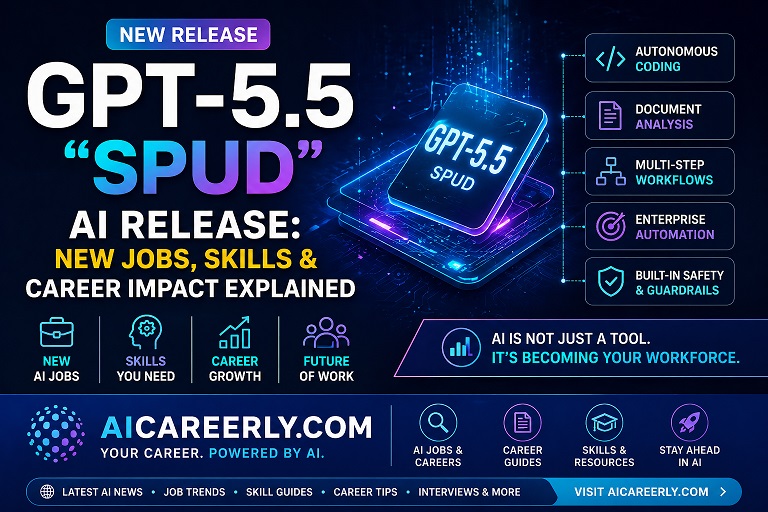
OpenAI has released GPT-5.5 (“Spud”), a next-generation AI model designed for autonomous, multi-step task execution. Unlike earlier models, GPT-5.5 can plan, execute, and refine workflows with minimal human input.
This shift marks a major transition in the AI industry, from prompt-based tools to agentic AI systems capable of performing real work tasks. For AI professionals, this means rapid changes in job roles, required skills, and enterprise AI adoption strategies.
Google Commits $185B to AI Infrastructure as Cloud Competition Intensifies
What Is New in GPT-5.5?
GPT-5.5 introduces a major leap in AI capability focused on autonomous task execution.
Key capabilities:
- Handles complex, multi-step workflows independently
- Plans tasks instead of waiting for step-by-step prompts
- Self-checks and refines outputs
- Strong improvements in coding, office work, and research tasks
- Works as a “chief of staff”-style AI agent in enterprise environments
Early enterprise users report:
- Significant reduction in manual workload
- Up to 10 hours saved per employee per week
- Improved document processing and task automation efficiency
The Shift From Chatbots to AI Agents
The biggest transformation is not just performance, it is autonomy.
AI systems are evolving from:
- ❌ Prompt-based assistants
to - ✅ Autonomous AI agents that execute workflows
What this means:
- Users assign tasks instead of writing prompts
- AI systems break tasks into steps automatically
- Models interact with tools, APIs, and enterprise systems
- Workflows become continuous and self-managed
This is the foundation of the emerging AI agent economy.
Impact on AI Engineering Roles
AI engineering roles are undergoing a structural transformation.
🔧 Declining focus:
- Basic prompt engineering
- Simple chatbot development
- Single-output AI applications
📈 Increasing demand:
- AI agent system architecture
- Multi-step workflow automation design
- Tool integration and API orchestration
- Enterprise AI deployment systems
- AI cost optimization and compute efficiency
Key takeaway:
AI engineers are becoming system designers for autonomous AI workflows, not just model users.
AI Chip Market Boom 2026: Jobs, Growth & AI Infrastructure Surge
New Skills AI Professionals Must Learn
1. High-demand skills:
- AI agent architecture design
- LLM orchestration frameworks
- Retrieval-augmented generation (RAG) systems
- Multi-tool AI workflow engineering
- AI evaluation and reliability testing
- Compute and token cost optimization
2. Skills losing importance:
- Basic prompt crafting
- Simple text-generation pipelines
- Manual reporting automation
Impact on AI Product, Research, and Enterprise Teams
1. AI Research Teams
- Focus shifting toward long-context reasoning
- Emphasis on task completion success, not just accuracy
- Increased work on autonomous planning models
2. AI Product Teams
- Products evolving into AI agent platforms
- Interfaces shifting from chat → delegation systems
- Rise of “AI co-worker” applications
3. Enterprise AI Teams
- Rapid adoption of internal AI agents
- Automation of documentation, reporting, and coding workflows
- Growing need for governance and audit systems
AI Job Market Impact
🚀 Emerging job roles:
- AI Agent Architect
- LLM Workflow Engineer
- AI Automation Engineer
- Enterprise AI Integration Specialist
- AI Cost Optimization Engineer
- AI Governance & Compliance Specialist
🔄 Evolving roles:
- Software engineers → AI-integrated engineers
- Data scientists → AI workflow designers
- DevOps engineers → AI infrastructure engineers
- Product managers → AI system designers
⚠️ Roles under pressure:
- Entry-level repetitive coding roles
- Basic content generation jobs
- Manual reporting and documentation roles
These roles are not disappearing, but are rapidly becoming AI-assisted roles.
China Humanoid Robot Half-Marathon: What It Really Reveals About AI Progress
Career Guidance for AI Professionals
What you should focus on now:
1. Learn AI agent systems
Understand how to design systems that:
- break tasks into steps
- use tools automatically
- validate and refine outputs
2. Build real-world AI workflows
Move beyond chatbots and focus on:
- automation pipelines
- enterprise workflows
- multi-step AI systems
3. Understand AI infrastructure economics
- Token efficiency
- GPU usage optimization
- Model deployment cost structures
4. Develop evaluation expertise
Learn how to measure:
- task completion reliability
- system autonomy performance
- error correction behavior
The Bigger Picture: A Compute-Driven Economy
GPT-5.5 reinforces a major industry trend:
AI is becoming infrastructure, not just software.
Key shifts include:
- Work defined by compute capacity
- AI performance tied to infrastructure efficiency
- Enterprises scaling AI like cloud systems
- Cost per token becoming a strategic business metric
AI Job Market 2026: Top Skills, Agentic AI Trends & Career Guide
Final Outlook: The Future of AI Careers
The AI job landscape is rapidly reorganizing.
We are moving toward a world where:
- AI systems execute entire workflows
- Humans design systems instead of tasks
- Productivity is driven by compute and automation
- Companies operate hybrid human–AI workforces
The key transition for professionals:
From using AI tools → to building AI systems that do the work
Key Takeaway for AI Professionals
GPT-5.5 signals a clear industry direction: agentic AI systems are becoming the core of enterprise automation and AI careers. Professionals who understand AI workflows, agent architecture, and system-level design will define the next wave of opportunities.
.
Frequently Asked Questions (FAQs) – GPT-5.5 AI Jobs & Career Impact
1. What is GPT-5.5 and why is it important for AI careers?
GPT-5.5 is a next-generation AI model designed to handle multi-step tasks more autonomously. It is important because it marks a shift from simple chat-based AI to agent-like systems that can execute real work, directly affecting AI job roles and required skills.
2. How does GPT-5.5 change the AI job market?
It increases demand for professionals who can build and manage AI systems rather than just use them. Roles in AI automation, system design, and enterprise AI integration are growing, while repetitive tasks are becoming more automated.
3. Will GPT-5.5 replace AI engineers or developers?
No, but it will change what they do. Engineers will focus more on designing AI workflows, integrating tools, and managing autonomous systems rather than writing repetitive code or prompts.
4. What new AI jobs are emerging because of GPT-5.5?
New roles include AI Agent Architect, AI Workflow Engineer, AI Systems Integrator, AI Automation Specialist, and AI Governance Engineer.
5. What skills should AI professionals learn now?
Key skills include AI agent design, workflow automation, LLM orchestration, API integration, AI system evaluation, and compute cost optimization.
6. How does GPT-5.5 affect entry-level AI jobs?
Entry-level roles focused on simple coding, content generation, or basic data tasks may decline. However, new entry points are emerging in AI tooling, automation setup, and system monitoring.
7. What is meant by “agentic AI” in GPT-5.5?
Agentic AI refers to systems that can independently plan, execute, and refine tasks instead of just responding to prompts. This includes using tools, breaking tasks into steps, and completing workflows.
8. How will enterprise companies use GPT-5.5?
Companies will use it to automate workflows such as documentation, coding assistance, reporting, customer operations, and internal knowledge processing.
9. What industries will be most affected by GPT-5.5?
Tech, finance, healthcare, education, customer support, and software development will be most affected due to high levels of knowledge-based and repetitive work.
10. What is the biggest takeaway for AI professionals?
The biggest shift is from using AI tools to building AI systems. Professionals who understand AI workflows, automation, and system-level design will have the strongest career advantage going forward.