Artificial intelligence has moved beyond pilot programs and experimental deployments. In 2026, AI agents are being integrated directly into enterprise operations at scale, marking a structural shift in how organizations design workflows, allocate labor, and define roles across departments. Recent industry survey data confirms that agentic AI has transitioned from early adoption to full production use across large enterprises, signaling a fundamental change in how work is executed inside modern companies.
The shift is no longer theoretical. AI systems are now embedded across core business functions, including IT operations, customer service, sales, marketing, and internal analytics. Instead of being treated as standalone tools, AI agents are increasingly designed as operational components that execute tasks, coordinate workflows, and support decision-making processes within enterprise systems.
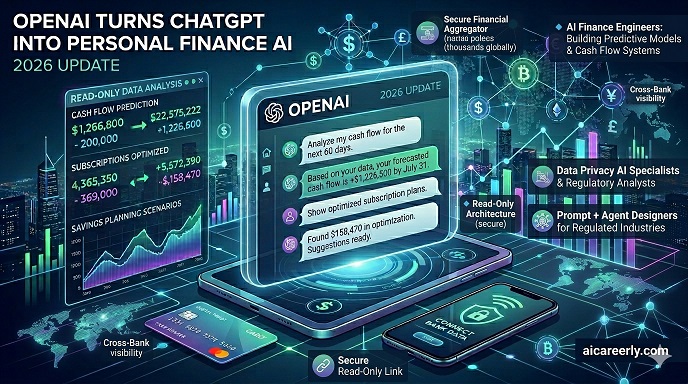
Also read: OpenAI Turns ChatGPT Into a Personal Finance AI – What It Means for AI Jobs, Banking, and the Future of Work (2026 Update)
A key finding from recent enterprise research is that AI adoption is no longer limited to efficiency-focused experiments. Organizations report that AI agents are already influencing a significant share of internal workflows, with continued expansion planned throughout 2026. Rather than replacing entire job categories, companies are breaking down complex workflows into smaller, automatable units that can be distributed across AI systems and human workers. This approach is reshaping job structures at a granular level.
The business justification for AI adoption has also evolved. Early adoption phases focused heavily on productivity gains and cost reduction. In 2026, enterprises increasingly assume that AI delivers value by default. The focus has shifted toward scalability, reliability, and safe integration into production environments. This change in mindset reflects a more mature stage of adoption, where AI is treated as infrastructure rather than an experimental advantage.
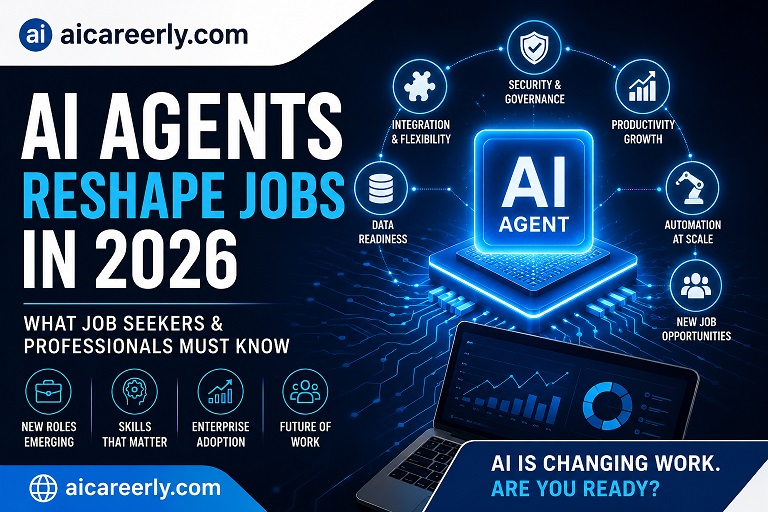
Security, governance, and system integration have emerged as the most important criteria in enterprise AI deployment. Organizations are prioritizing platforms that can operate reliably within existing technical environments while maintaining strict control over data, compliance, and operational risk. Performance and return on investment are no longer the primary decision factors; instead, enterprises are focused on ensuring that AI systems can function safely at scale within complex infrastructures.
Another notable trend is the preference for open and flexible systems. Many organizations are choosing to build AI agent systems on top of existing tools rather than adopting fully closed or proprietary ecosystems. This reflects a broader enterprise requirement for interoperability, particularly in industries with complex legacy systems such as financial services, manufacturing, and retail. The ability to integrate AI agents into existing workflows without major infrastructure replacement is becoming a key driver of adoption.
Check out: AI-Powered Hacking Has Exploded Into an Industrial-Scale Threat, Google Warns
Despite rapid progress, scaling AI across organizations is constrained by two persistent challenges: data readiness and workforce capability. Many enterprises already understand where AI can be applied, but struggle with integration complexity and a shortage of skilled professionals who can deploy and manage these systems effectively. This gap is becoming one of the most significant bottlenecks in enterprise AI expansion.
As a result, demand in the job market is shifting away from purely theoretical AI knowledge toward applied skills. Employers are increasingly looking for professionals who can design, deploy, and manage AI-driven workflows in real operational environments. Roles are emerging that combine domain expertise with AI system oversight, including positions focused on automation architecture, AI workflow integration, and governance of intelligent systems.
The impact of AI agents is now visible across nearly all major business functions. Information technology departments report the highest levels of transformation, followed by operations, customer-facing teams, and research and development units. The breadth of impact indicates that AI is no longer confined to technical teams but is becoming a shared operational layer across entire organizations.
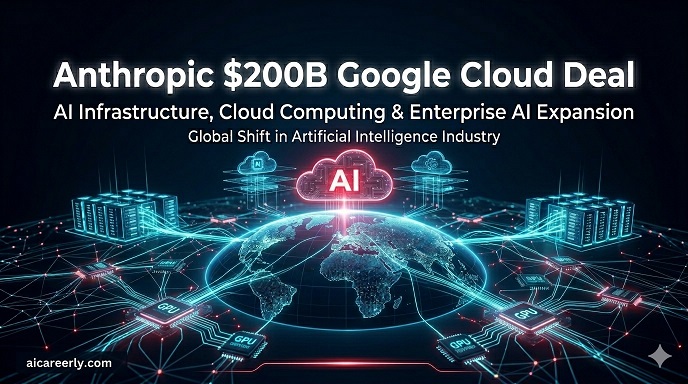
Most popular: Anthropic’s $200 Billion Google Cloud Commitment Signals a New Era for AI Infrastructure
For job seekers and professionals, this transition represents a shift in how work is defined rather than a simple displacement of roles. Routine execution tasks are increasingly handled by AI systems, while human roles are moving toward supervision, configuration, and optimization of automated workflows. The most valuable skills are evolving toward system thinking, integration capability, and the ability to work alongside AI agents as part of structured business processes.
The broader implication is that AI adoption in 2026 is not a future trend but an active restructuring of enterprise labor systems. Organizations are not only deploying new tools but redesigning how work itself is organized. For professionals navigating this environment, the competitive advantage lies in understanding how AI systems are embedded into workflows and how those systems reshape the nature of work across industries.