Introduction: A Turning Point in Global AI and Defense Strategy
The integration of artificial intelligence into military systems has moved from theoretical discussions to active deployment. A recent agreement between the U.S. Department of Defense and major technology companies marks one of the most significant shifts in modern defense strategy.
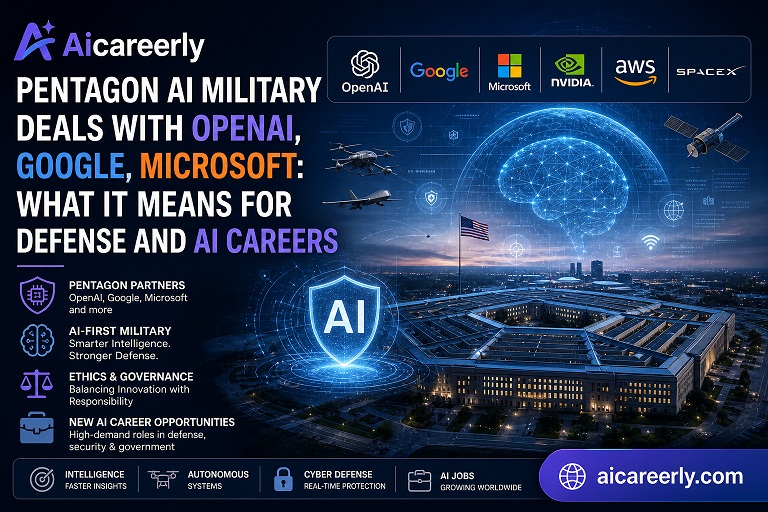
The Pentagon has partnered with leading AI and cloud computing firms, including OpenAI, Google, Microsoft, Nvidia, Amazon Web Services, and SpaceX—to accelerate the adoption of artificial intelligence across defense operations. These partnerships aim to strengthen intelligence processing, battlefield decision-making, and autonomous systems development.
At the core of this collaboration is a controversial clause allowing “any lawful use” of AI technologies. While this enables rapid deployment and experimentation, it has also raised concerns about ethical boundaries, transparency, and long-term governance.
At the same time, notable AI safety-focused companies such as Anthropic have declined participation, citing risks related to surveillance and autonomous weapons.
This development signals a new era where artificial intelligence is not just transforming industries—but also reshaping global security frameworks.
GPT-5.5 “Spud” AI Release: New Jobs, Skills & Career Impact Explained
Major Companies Involved in the Pentagon AI Agreements
The Pentagon’s AI integration strategy includes partnerships with some of the most influential technology companies in the world:
- OpenAI – advanced generative AI systems and decision support models
- Google – AI research, cloud infrastructure, and machine learning platforms
- Microsoft – secure cloud computing and defense-grade AI systems
- Nvidia – high-performance AI chips and computing infrastructure
- Amazon Web Services – scalable cloud infrastructure for defense networks
- SpaceX – satellite and communications infrastructure for military systems
Additionally, emerging AI startups such as Reflection AI are also included in broader defense-related innovation efforts.
These partnerships reflect a growing convergence between Silicon Valley innovation and national defense priorities.
What “AI-First Military” Actually Means
The concept of an “AI-first military” refers to the integration of artificial intelligence across nearly every aspect of defense operations.
This includes:
1. Intelligence Processing
AI systems analyze massive datasets from satellites, sensors, and communication networks to identify threats faster than human analysts.
2. Decision Support Systems
Machine learning models assist commanders by simulating scenarios and recommending strategic actions in real time.
3. Autonomous Systems
AI is increasingly being used in drones, surveillance systems, and robotic platforms capable of operating with limited human input.
4. Cyber Defense
AI helps detect and respond to cyber threats in milliseconds, improving national security resilience.
The goal is not necessarily to replace human decision-making, but to significantly enhance speed, accuracy, and operational efficiency.
The “Any Lawful Use” Policy and Why It Is Controversial
One of the most debated aspects of the Pentagon’s agreements is the requirement that companies allow their AI systems to be used for “any lawful use.”
In practice, this means:
- The military can deploy AI systems across a wide range of defense applications
- Companies have limited control over how their models are operationally used once deployed
- Ethical restrictions are largely dependent on legal frameworks rather than internal corporate policies
Concerns Raised
Critics argue this approach creates potential risks such as:
- Expanded surveillance capabilities
- Reduced transparency in AI-driven military decisions
- Increased reliance on autonomous systems in conflict environments
- Difficulty enforcing ethical safeguards after deployment
This has created a divide between companies prioritizing rapid deployment and those emphasizing strict AI safety boundaries.
Google Commits $185B to AI Infrastructure as Cloud Competition Intensifies
Ethical Concerns and Industry Divisions
Not all AI companies have agreed to participate in the Pentagon’s framework.
Anthropic has notably refused involvement in contracts that include broad deployment clauses. The company has raised concerns about:
- AI systems being used for mass surveillance
- Lack of constraints on autonomous weapons
- Insufficient oversight in high-risk deployments
This reflects a broader philosophical split in the AI industry:
- Deployment-first companies prioritize scale, adoption, and integration
- Safety-first companies emphasize governance, alignment, and controlled usage
The disagreement highlights one of the most important challenges in modern AI development: balancing innovation with ethical responsibility.
Why This Matters Globally
The implications of these agreements extend far beyond the United States.
1. Global Military AI Competition
Other nations are likely to accelerate their own AI defense programs in response, increasing global competition in autonomous systems.
2. Shift in Power Dynamics
AI becomes a strategic asset comparable to nuclear technology or cybersecurity dominance.
3. Acceleration of Autonomous Warfare Systems
The use of AI in defense reduces decision timelines, potentially changing the nature of modern conflict.
4. Regulatory Pressure
Governments and international bodies may introduce stricter frameworks governing military AI usage.
5. Expansion of AI Infrastructure Markets
Cloud computing, chip manufacturing, and model deployment systems are becoming critical components of national security infrastructure.
How This Impacts AI Professionals and Future Careers
One of the most significant consequences of this shift is its impact on global AI employment opportunities.
Rising Demand in Defense and Security AI
Governments are becoming major employers of AI talent, particularly in:
- Defense research organizations
- Cybersecurity agencies
- Intelligence analysis units
- Military technology contractors
High-Growth AI Roles Emerging
The defense-AI ecosystem is driving demand for specialized roles such as:
- Machine Learning Engineers – building predictive and decision-making systems
- AI Security Specialists – protecting models from adversarial attacks and exploitation
- MLOps Engineers – deploying and scaling AI systems in secure environments
- AI Ethics & Governance Experts – ensuring responsible and compliant AI usage
Governments as Major AI Employers
Unlike previous decades where AI careers were dominated by private tech firms, governments are now:
- Investing heavily in AI infrastructure
- Hiring specialized machine learning talent
- Collaborating with private sector AI companies at scale
New Opportunities in High-Security Systems
AI professionals may increasingly work on:
- Classified machine learning models
- Secure cloud-based defense systems
- Real-time intelligence analysis platforms
- Autonomous system safety protocols
AI Chip Market Boom 2026: Jobs, Growth & AI Infrastructure Surge
Skills Needed to Stay Competitive
AI professionals aiming to enter this field should focus on:
- Secure model deployment practices
- Cloud infrastructure expertise (AWS, Azure, GCP)
- Adversarial machine learning awareness
- Compliance and regulatory understanding
- Scalable system design for mission-critical environments
This shift signals that AI careers are expanding beyond commercial applications into national infrastructure and defense systems.
Conclusion: The Future of AI in Defense and Employment
The Pentagon’s integration of artificial intelligence through partnerships with major technology companies represents a defining moment in the evolution of global defense systems.
It highlights a clear trend: AI is no longer just a commercial innovation, it is becoming a core component of national security infrastructure. At the same time, ethical debates around surveillance, autonomy, and control continue to shape how these systems are developed and deployed.
For professionals in the AI field, this transition opens new pathways across defense technology, cybersecurity, and high-performance computing environments. It also increases demand for specialized skills in secure deployment, governance, and system integrity.
The convergence of AI and defense is expected to accelerate in the coming years, creating both opportunities and responsibilities for the global AI workforce.
👉 Explore AI career opportunities and learn in-demand AI skills to stay ahead in this rapidly evolving industry.