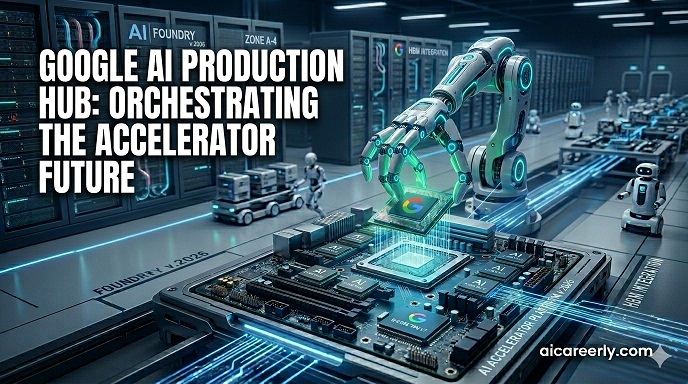
Google has confirmed it will invest up to $185 billion in capital expenditure in 2026, with artificial intelligence infrastructure as its central priority. The announcement was reinforced by CEO Sundar Pichai during the Google Cloud Next 2026 summit.
The company is significantly increasing its commitment to AI systems, with more than half of its machine learning compute resources now allocated to cloud-based AI workloads. This positions Google Cloud as a core pillar of the company’s long-term strategy alongside search and advertising.
The decision reflects a broader industry shift where AI infrastructure is becoming a primary driver of corporate investment rather than a secondary research function.
AI Chip Market Boom 2026: Jobs, Growth & AI Infrastructure Surge
Strategic Shift Toward AI-First Infrastructure
Google’s spending signals a transition from traditional cloud expansion to AI-optimized infrastructure development. This includes large-scale data centers, specialized AI accelerators, and distributed compute systems designed for training and deploying advanced machine learning models.
The scale of investment indicates that AI development is increasingly dependent on physical infrastructure capacity rather than software optimization alone.
In practical terms, Google is building infrastructure designed specifically for continuous AI model training, deployment, and enterprise integration.
Cloud Computing Becomes an AI Execution Layer
Google Cloud is evolving from a standard infrastructure service into an AI execution platform. Enterprises using Google Cloud are increasingly relying on it for:
- Large language model deployment
- Automated business workflows
- AI-driven analytics and decision systems
- Scalable machine learning pipelines
This transition places Google in direct competition with other hyperscale cloud providers as demand for AI computing resources accelerates. The focus is shifting from general-purpose cloud services to specialized AI compute ecosystems.
Compute Capacity as a Competitive Advantage
A key implication of Google’s investment strategy is the growing importance of compute capacity as a competitive factor in AI development.
Access to large-scale computing resources determines the speed and scale at which AI models can be trained and deployed. By expanding infrastructure aggressively, Google is positioning itself to maintain leadership in both foundational model development and enterprise AI services.
This reflects a broader industry reality: AI progress is increasingly constrained by infrastructure availability rather than algorithmic innovation alone.
China Humanoid Robot Half-Marathon: What It Really Reveals About AI Progress
Implications for AI Jobs and Workforce Demand
The expansion of AI infrastructure is reshaping demand in the global technology labor market. Several key areas of job growth are emerging:
1. AI Infrastructure Engineering
Roles focused on building and maintaining large-scale cloud and data center systems are expanding rapidly. This includes distributed systems engineering and hardware optimization.
2. Machine Learning Operations (MLOps)
Deployment, monitoring, and scaling of AI models in production environments is becoming a critical function across enterprises.
3. Cloud AI Specialization
Skills in platforms such as Google Cloud, AWS, and Azure are increasingly required for AI-related positions, particularly in enterprise environments.
4. Applied AI Development
Demand is shifting toward professionals who can integrate AI systems into business workflows, rather than solely developing models. The overall trend indicates a transition from experimental AI research roles to large-scale operational deployment roles.
Investor Concerns and Long-Term Strategy
While the scale of Google’s capital expenditure has raised concerns about short-term profitability, the investment reflects a long-term infrastructure strategy.
The current phase of the AI industry is characterized by heavy upfront spending on compute, data centers, and chip supply chains. Revenue generation is expected to follow through enterprise adoption, cloud services expansion, and AI-powered products.
This positions AI infrastructure as a foundational layer of future digital economies rather than a short-term product cycle.
Global AI Infrastructure Competition
Google’s investment is part of a wider global trend where major technology companies are rapidly expanding AI infrastructure capabilities. Cloud providers are increasing data center capacity, semiconductor companies are scaling AI-specific chips, and governments are beginning to treat AI infrastructure as strategically important. This creates a competitive environment similar to earlier global buildouts of electricity grids and internet infrastructure, where scale and early investment determine long-term leadership.
Outlook for AI Professionals and Job Seekers
For AI professionals, the current environment presents several clear trends:
- Continued expansion of cloud and infrastructure-related AI roles
- Increasing demand for production-ready AI system deployment skills
- Growth in enterprise AI integration positions
- Rising importance of cloud certifications and distributed systems knowledge
The AI job market is moving toward operational scale, where the ability to deploy and manage systems at enterprise level is becoming as important as model development.
AI Job Market 2026: Top Skills, Agentic AI Trends & Career Guide
Conclusion
Google’s $185 billion investment commitment marks a structural shift in how artificial intelligence is being developed and deployed. AI is no longer confined to research labs or isolated applications. It is becoming embedded in large-scale infrastructure systems that power global cloud platforms and enterprise operations.
The industry is entering a phase defined by compute scale, infrastructure dominance, and operational deployment. For AI professionals, this shift is reshaping both required skills and long-term career opportunities.
The direction is clear: AI infrastructure is becoming one of the central pillars of global technology development.
.