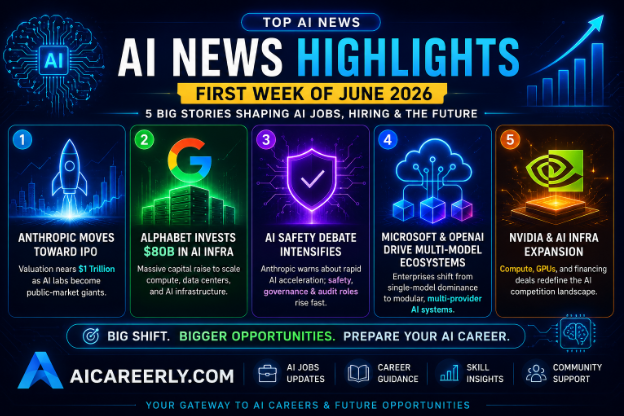
The first week of June 2026 marks one of the most significant turning points in the global AI industry. What was once a research-driven field has now fully transformed into a capital-intensive, infrastructure-heavy ecosystem where trillion-dollar valuations, compute wars, and regulatory pressure are reshaping how companies hire and scale.
For AI professionals, engineers, researchers, and job seekers, these developments are not just news, they are direct signals of where the highest-paying and fastest-growing opportunities will emerge next.
Below is a breakdown of the five most important AI industry developments in the previous week and what they mean for your career.
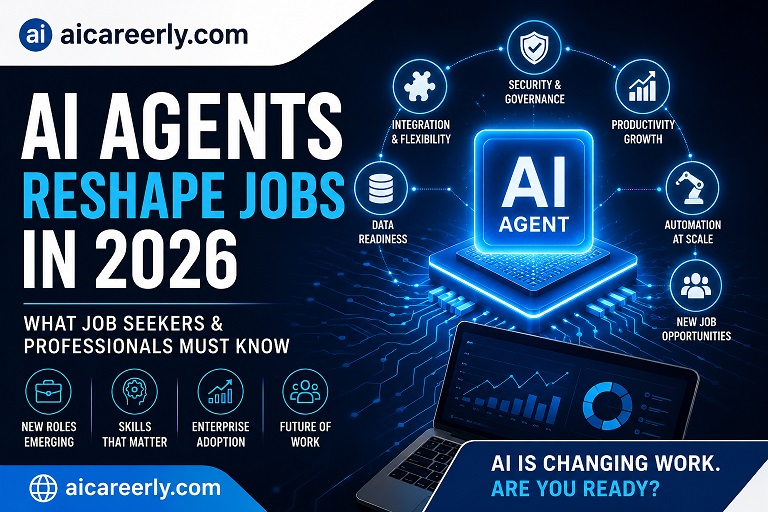
AI Agents Enter Enterprise at Full Scale in 2026: What It Means for Jobs and Careers
1. Anthropic Moves Toward IPO Near $1 Trillion Valuation
Anthropic has reportedly taken steps toward a confidential U.S. IPO, with its valuation approaching the trillion-dollar range following its latest funding cycle.
This positions the company among the most valuable AI labs globally and signals a major structural shift: frontier AI companies are moving from private research labs into public-market technology giants.
Why this matters for AI professionals
This shift creates immediate career impacts:
- Expansion of enterprise AI engineering teams
- Rapid scaling of infrastructure and model deployment roles
- Increased hiring pressure ahead of public listing requirements
- Stronger demand for experienced ML and systems engineers
As AI labs transition into publicly accountable companies, hiring becomes more aggressive, structured, and globally competitive.
2. Alphabet Injects Massive Capital into AI Infrastructure Expansion
Alphabet’s reported $80 billion capital expansion plan highlights a critical industry shift: AI competition is no longer just about model performance, it is about compute dominance.
Instead of prioritizing financial returns or share buybacks, Big Tech is now investing heavily in:
- GPU and TPU scaling
- AI data center expansion
- Distributed training infrastructure
- High-performance cloud systems
This signals a long-term bet on AI infrastructure as the foundation of digital economies.
Career impact
This is driving demand for a new class of roles:
- AI infrastructure engineers
- Distributed systems specialists
- GPU optimization experts
- Cloud-native AI architects
Professionals who understand both AI systems and infrastructure scaling are becoming highly competitive in the job market.
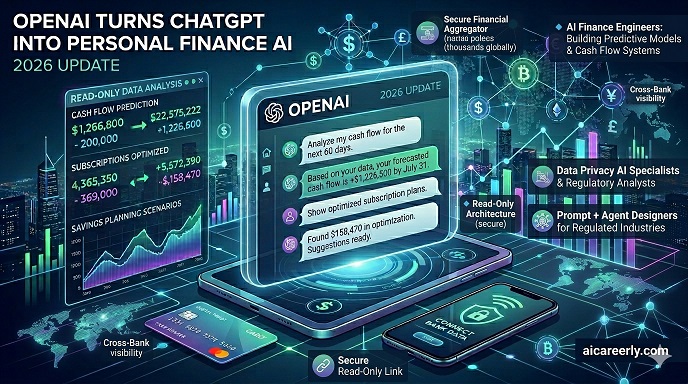
OpenAI Turns ChatGPT Into a Personal Finance AI – What It Means for AI Jobs, Banking, and the Future of Work (2026 Update)
3. AI Safety Debate Intensifies as Automation Accelerates
Frontier AI organizations are raising concerns about the pace of AI advancement relative to societal and institutional readiness. Internal reports suggest AI systems are already contributing significantly to software development workflows, in some cases generating large portions of production-level code.
This acceleration has triggered renewed debate around governance and safety.
Emerging concerns
- Lack of standardized AI oversight frameworks
- Rapid automation of software engineering tasks
- Risk of misalignment between capability and regulation
Career impact
This is creating entirely new job categories:
- AI safety researcher
- Model auditing engineer
- AI compliance specialist
- Governance and policy-tech hybrid roles
AI safety is no longer a theoretical field, it is becoming an operational requirement in enterprise AI deployment.
4. Microsoft and OpenAI Signal Shift Toward Multi-Model AI Ecosystems
Recent developments from Microsoft and OpenAI indicate a move away from single-model ecosystems toward modular, multi-provider AI systems. Enterprises are increasingly adopting architectures where multiple AI models are used in parallel depending on task requirements.
This is driving the rise of:
- AI agent orchestration systems
- Multi-model routing frameworks
- Cloud-agnostic AI pipelines
What this means for engineers
The industry is now prioritizing integration over isolation.
High-value skills include:
- Building LLM-based agent systems
- Multi-cloud AI deployment
- API-level model orchestration
- Enterprise AI workflow design
Engineers who can connect multiple AI systems into scalable applications are becoming more valuable than those focused on single-model specialization.
5. NVIDIA-Driven Compute Expansion Redefines AI Competition
Behind the visible headlines, a deeper structural shift is taking place: compute infrastructure is becoming the core battleground of AI.
Recent trends include:
- Expansion of GPU financing ecosystems
- Growth of high-parameter AI model training systems
- Increased investment in distributed compute networks
The key shift is simple but profound:
AI leadership is no longer defined only by algorithms, but by control of compute, infrastructure, and distribution networks.
Career implications
This is driving demand for highly specialized technical roles:
- GPU cluster optimization engineers
- AI systems architects
- Distributed training engineers
- High-performance compute specialists
Understanding hardware constraints is becoming just as important as understanding model architecture.
AI-Powered Hacking Has Exploded Into an Industrial-Scale Threat, Google Warns
What This Means for AI Jobs in 2026
Across all five developments, three major structural trends define the current AI job market.
1. AI Companies Are Becoming Infrastructure-Scale Corporations
AI labs are evolving into global infrastructure providers with public-market pressure, requiring:
- scalable engineering teams
- enterprise-grade systems
- global hiring pipelines
2. Infrastructure Skills Are Now More Valuable Than Pure Model Research
The highest hiring growth is in:
- AI systems engineering
- cloud deployment
- distributed compute optimization
Production-focused AI engineers are in highest demand.
3. Hybrid Skill Sets Dominate the Job Market
The most competitive roles now combine disciplines:
- AI + cloud engineering
- AI + cybersecurity
- AI + governance and compliance
- AI + product systems design
Pure specialization is being replaced by cross-domain capability.
📌 Final Insight
The first week of June 2026 confirms a major truth about the AI industry: It is no longer a model race, it is a global infrastructure and capital race. For AI professionals and job seekers, the opportunity landscape is expanding rapidly, but the skill requirements are becoming more technical, more integrated, and more system-oriented. Those who adapt early to infrastructure-level AI skills will be positioned at the center of the next hiring wave.