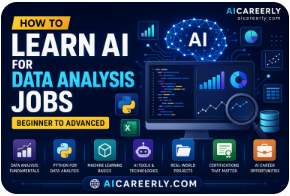
Artificial intelligence is transforming how organizations collect, analyze, and use data. Businesses increasingly rely on AI-powered insights to improve decision-making, automate workflows, and identify opportunities faster than ever before. As a result, professionals who can combine data analysis skills with AI knowledge are in growing demand.
If you want to learn AI for data analysis jobs, the good news is that you do not need a computer science degree to get started. With the right learning roadmap, practical projects, and consistent practice, you can build valuable AI skills and prepare for a rewarding AI career.
Best AI Cover Letter Generators That Actually Work
Why AI Skills Matter in Modern Data Analysis
Traditional data analysis focuses on understanding historical data and identifying trends. AI takes this a step further by enabling predictive analytics, automation, and intelligent decision-making.
Companies today use AI to:
- Forecast sales and demand
- Detect fraud and anomalies
- Analyze customer behavior
- Automate reporting tasks
- Improve business intelligence
Learning AI skills can help data professionals work more efficiently and solve complex problems that were previously difficult to address using traditional methods alone.
What Does an AI Data Analyst Do?
An AI data analyst combines data analytics techniques with artificial intelligence tools and machine learning concepts.
Typical responsibilities include:
- Collecting and cleaning datasets
- Analyzing trends and patterns
- Building predictive models
- Creating dashboards and visualizations
- Using AI tools to automate analysis
- Presenting insights to stakeholders
For example, an AI data analyst might use machine learning to predict customer churn instead of simply reporting past customer behavior.
Top AI Tools to Find Jobs Faster in 2026 (Complete Guide for Job Seekers)
Essential Skills You Need Before Learning AI
Before diving into advanced AI topics, it’s important to build a strong foundation.
Data Analysis Fundamentals
Learn how to:
- Gather and organize data
- Clean inaccurate datasets
- Interpret business metrics
- Create meaningful reports
Free learning options include YouTube tutorials, blogs, and open online courses.
Statistics and Data Visualization
Statistics helps you understand data and evaluate results accurately.
Focus on:
- Mean, median, and mode
- Probability basics
- Correlation and regression
- Hypothesis testing
Visualization tools such as Power BI and Tableau help communicate insights effectively.
Basic Programming Skills
Programming is essential for working with large datasets and AI tools.
Focus on:
- Variables and data types
- Loops and functions
- Working with files
- Data manipulation
Python is the most widely used language for data analysis and AI.
Step 1: Learn Python for Data Analysis
Python for data analysis is often the first technical skill aspiring AI professionals should learn.
Why Python?
- Beginner-friendly syntax
- Large community support
- Powerful data science ecosystem
- Extensive AI and machine learning libraries
Start by learning:
- Python fundamentals
- Data structures
- File handling
- Data cleaning techniques
Practical example:
Download a public dataset and use Python to identify trends, calculate averages, and generate simple reports.
Free Cover Letter Templates That Actually Get Interviews (2026 Guide)
Step 2: Master Data Analysis Tools and Libraries
Once you understand Python basics, learn the most important data analytics tools and libraries.
Pandas
Pandas is the primary library for working with structured data.
You can use it to:
- Import spreadsheets
- Clean datasets
- Filter records
- Perform calculations
Most real-world data analysis projects rely heavily on Pandas.
NumPy
NumPy supports numerical computing and mathematical operations.
It helps with:
- Array processing
- Statistical calculations
- Performance optimization
- Data transformations
Many machine learning frameworks depend on NumPy.
Matplotlib and Seaborn
Data visualization is a critical skill for any AI data analyst.
These libraries help create:
- Line charts
- Bar graphs
- Scatter plots
- Heatmaps
Visualizations often make complex findings easier for decision-makers to understand.
Step 3: Understand Machine Learning Fundamentals
Machine learning is a key component of AI.
Focus on understanding:
- Supervised learning
- Unsupervised learning
- Classification models
- Regression models
- Model evaluation
Popular beginner projects include:
- House price prediction
- Customer churn prediction
- Sales forecasting
You do not need advanced mathematics initially. Focus on understanding concepts and practical applications first.
How to Use AI to Optimize Your CV for ATS (2026 Guide)
Step 4: Learn AI Tools Used by Data Analysts
Modern AI data analysts increasingly use AI-powered tools to improve productivity.
Popular tools include:
- ChatGPT for research and data interpretation
- Microsoft Copilot for analytics assistance
- Power BI AI features
- Google Colab for machine learning projects
- Jupyter Notebook for experimentation
These tools can automate repetitive tasks and help accelerate analysis workflows.
Step 5: Build Real-World AI Data Analysis Projects
Projects are often more valuable than certificates alone.
Strong portfolio projects include:
- Customer segmentation analysis
- E-commerce sales forecasting
- Financial trend prediction
- Marketing campaign analysis
- Employee attrition prediction
Employers want evidence that you can apply AI skills to solve real business problems.
Publish your projects on GitHub and document your process clearly.
Step 6: Earn Relevant Certifications
While certifications are not mandatory, they can strengthen your resume.
Popular options include:
- Google Data Analytics Certificate
- IBM Data Science Professional Certificate
- Microsoft Data Analyst Certification
- AI and Machine Learning courses from major learning platforms
Free learning resources are excellent for skill building, while paid certifications may provide additional credibility.
Choose certifications that include hands-on projects rather than purely theoretical content.
Step 7: Create a Portfolio That Gets Attention
Your portfolio should demonstrate practical experience.
Include:
- Project descriptions
- Business problems solved
- Data sources used
- Visualizations
- Key findings
- GitHub links
A strong portfolio can help career changers compete with candidates who have formal experience.
Quality matters more than quantity. Three excellent projects are often better than ten incomplete ones.
Common Mistakes Beginners Should Avoid
Many learners slow their progress by making avoidable mistakes.
Common issues include:
- Learning tools without building projects
- Skipping statistics fundamentals
- Focusing only on theory
- Ignoring data cleaning skills
- Trying to learn everything at once
Follow a structured roadmap and apply each skill through practical projects.
AI Data Analysis Career Paths
Learning AI for data analysis jobs can lead to multiple career opportunities.
Potential roles include:
- AI Data Analyst
- Business Intelligence Analyst
- Data Analyst
- Junior Data Scientist
- Analytics Consultant
- Machine Learning Analyst
As your experience grows, you may move into advanced data science or AI engineering roles.
Frequently Asked Questions
Can I learn AI for data analysis without a computer science degree?
Yes. Many successful AI data analysts come from business, finance, marketing, engineering, and other non-computer science backgrounds. Practical skills and project experience often matter more than your degree field.
How long does it take to learn AI for data analysis jobs?
For most beginners, building job-ready skills typically takes several months of consistent learning and practice. Progress depends on your background, study schedule, and project experience.
Is Python necessary for AI data analysis?
While other tools exist, Python remains the most widely used language for AI and data analysis. Learning Python significantly expands your career opportunities.
Which AI tools should beginners learn first?
Start with Python, Jupyter Notebook, Pandas, and basic machine learning tools. Later, explore AI assistants, Power BI AI features, and advanced machine learning frameworks.
Final Thoughts
Learning AI for data analysis jobs is one of the most practical ways to future-proof your career. Start with data analysis fundamentals, learn Python for data analysis, master key libraries, understand machine learning concepts, and build real-world projects that showcase your abilities.
Remember that employers value demonstrated skills more than completed courses alone. Focus on creating a portfolio that highlights your problem-solving abilities and your understanding of real business challenges.
The best time to start is now. Continue learning, build meaningful projects, earn relevant certifications, and explore AI career opportunities that align with your interests and long-term goals. Every project you complete brings you one step closer to becoming a successful AI data analyst.