Introduction
For years, the tech industry pushed a simple narrative: no degree, no career. In AI, that assumption is rapidly collapsing. Today, hiring is shifting toward skills-based evaluation, where what you can build matters more than what you studied. Leading companies like Google and IBM have already removed strict degree requirements for many technical roles.
At the same time, the demand for AI talent is exploding across industries, from healthcare to finance to e-commerce, creating a massive opportunity for self-taught professionals. If you’re willing to learn, build, and prove your skills, you can absolutely become an AI specialist without a degree.
This guide gives you a realistic, step-by-step roadmap to achieve just that.
Top AI Skills Companies Are Hiring for in 2026 (High-Paying Guide)
🧠 What Does an AI Specialist Do?
An AI specialist designs, builds, and deploys intelligent systems that can learn from data and make decisions.
Core Responsibilities:
- Build and train machine learning models
- Analyze and preprocess large datasets
- Develop AI-powered applications
- Deploy models into real-world systems
- Optimize model performance
Key Specializations:
- Machine Learning (ML): Predictive models, regression, classification
- Natural Language Processing (NLP): Chatbots, text analysis
- Computer Vision (CV): Image recognition, object detection
- AI Automation: Workflow automation using AI tools
AI is not one job, it’s a family of roles, and you can specialize based on your strengths.
❓ Can You Really Become an AI Specialist Without a Degree?
Yes, and here’s why:
1. Skills > Credentials
Employers care about what you can do, not what diploma you hold.
2. Portfolio > Resume
A GitHub repository with real projects beats a generic CV.
3. Certifications + Projects = Proof
Online learning + hands-on work creates credibility.
In short:
👉 Demonstrated ability is your new degree
🧭 STEP-BY-STEP ROADMAP TO BECOME AN AI SPECIALIST
This is your practical, no-nonsense path.
Step 1: Learn the Fundamentals
Before touching AI, build a solid base.
Core Skills:
- Python Programming
- Basic Math
- Statistics (mean, variance, probability)
- Linear algebra (vectors, matrices)
- Data Handling
- Pandas, NumPy
- Data cleaning
What to Focus On:
- Writing clean Python code
- Understanding how data flows through systems
👉 Without this, everything else becomes difficult.
How to Automate Your Job Search Using AI (Save 10+ Hours Weekly)
Step 2: Learn Core AI Skills
Now you move into real AI.
Must-Learn Areas:
- Machine Learning algorithms
- Model evaluation (accuracy, precision, recall)
- Deep Learning basics
- One specialization:
- NLP or Computer Vision
Key Frameworks:
- TensorFlow
- PyTorch
What You Should Be Able To Do:
- Train a model
- Evaluate results
- Improve performance
Step 3: Use AI Tools to Learn Faster
This is where modern learners gain an advantage.
Use tools like ChatGPT to:
- Explain complex concepts instantly
- Debug your code
- Generate project ideas
- Simulate interview questions
👉 Think of AI as your 24/7 tutor
Step 4: Build Real Projects (CRITICAL)
This is the most important step.
Without projects, you are not job-ready.
Top High-Income AI Careers Without a Degree (2026 Guide)
Portfolio Project Ideas:
| Project | Skills Demonstrated |
|---|---|
| Chatbot | NLP, APIs |
| Recommendation System | ML, data analysis |
| Image Classifier | Computer vision |
| Fraud Detection Model | Classification |
| Resume Screening AI | NLP + real-world use case |
Where to Host:
- GitHub
What Recruiters Look For:
- Clean code
- Real-world problem solving
- Documentation
👉 One strong project > 10 weak tutorials
Step 5: Get Certifications (Optional but Helpful)
Certifications help—but only if combined with projects.
Recommended Platforms:
- Coursera
- edX
Focus on:
- Machine Learning certifications
- AI specialization tracks
👉 Use them to structure learning, not replace practice.
Step 6: Gain Real-World Experience
Experience matters, even unpaid at first.
Ways to Gain Experience:
- Freelancing (Upwork, Fiverr)
- Internships
- Open-source contributions
- Personal startup projects
Strategy:
Start small → build credibility → increase rates/opportunities
Step 7: Apply for Jobs Strategically
Don’t apply randomly—apply smart.
Optimize Your CV:
- Highlight projects first
- Use AI keywords (ML, NLP, Python)
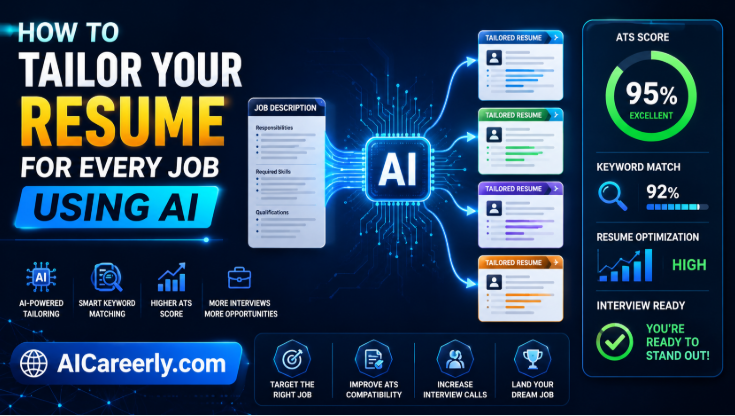
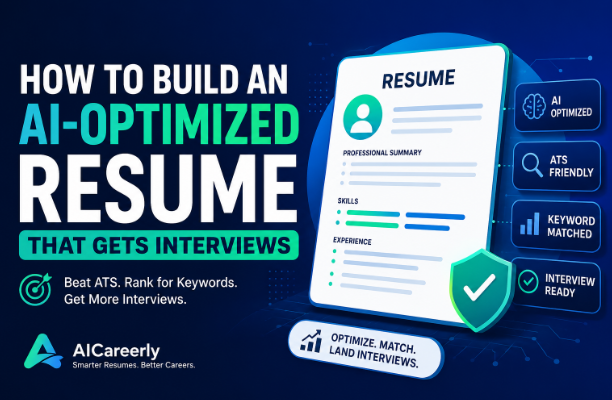
- Tailor for ATS systems
Smart Application Strategy:
- Target startups (more flexible hiring)
- Apply globally (remote roles)
- Customize each application
👉 Use AI tools to tailor resumes for each job.
Top AI Mock Interview Tools to Practice & Get Hired Faster in 2026
💼 Best Entry-Level AI Roles
Here are realistic entry points:
| Role | Description | Key Skills |
|---|---|---|
| Junior Data Scientist | Analyze data & build models | Python, statistics |
| Machine Learning Engineer | Deploy ML systems | ML, APIs, deployment |
| AI Analyst | Interpret AI-driven insights | Data analysis |
| NLP Engineer | Work with text data | NLP, Python |
| AI Intern | Entry-level training role | Fundamentals |
💰 Salary Expectations (2026)
Entry-Level:
- $60,000 – $90,000/year (global average)
Mid-Level:
- $100,000 – $150,000+
High-Paying Regions:
- USA, UK, Canada, Germany
- Remote global companies
👉 Freelancers can earn $30–$150/hour depending on expertise.
🧰 Best Tools to Learn and Work in AI
Here’s your core stack:
- Python
- TensorFlow
- PyTorch
- Jupyter Notebook
- GitHub
How to Stand Out Without a Degree
This is where most people fail.
What Actually Works:
- Build a strong portfolio
- Show real results (metrics, performance)
- Pick a niche (NLP, CV, etc.)
- Document your work publicly
- Network on LinkedIn & GitHub
👉 Your visibility = your opportunity pipeline
Best AI Resume Builders in 2026 (Tested & Ranked)
⚠️ Common Mistakes to Avoid
1. Learning Without Building
Watching tutorials ≠ skills
2. Skipping Fundamentals
Weak basics = long-term struggle
3. Waiting for Certifications
You don’t need “perfect readiness” to apply
4. Not Choosing a Focus
Generalists struggle—specialists win
Future of AI Careers (2026–2030)
The trend is clear:
- AI jobs will continue to grow rapidly
- Companies will prioritize skills verification over degrees
- More remote and global hiring opportunities
- Rise of portfolio-based hiring platforms
👉 Self-taught professionals will dominate entry-level pipelines
Conclusion
Becoming an AI specialist without a degree is not only possible, it is increasingly becoming the standard pathway into the field. What truly matters is mastering the fundamentals, consistently building real, practical projects, and accumulating hands-on experience that demonstrates capability. From there, success comes down to applying strategically to roles and opportunities that match your growing skill set. With sustained focus and consistency, it is entirely feasible to enter and progress in AI faster than through traditional academic routes. The key is to start immediately and commit to building something meaningful as early as this week.
.
❓ FAQs: Become AI Specialist Without Degree
1. Can I really become an AI specialist without a degree?
Yes, you can become an AI specialist without a degree by focusing on practical skills like Python, machine learning, and real-world projects. Many companies now prioritize portfolios and demonstrated ability over formal education.
2. What skills do I need to become an AI specialist without a degree?
To become an AI specialist without a degree, you need:
- Python programming
- Machine learning fundamentals
- Data analysis and statistics
- Basic deep learning knowledge
- Experience with frameworks like TensorFlow or PyTorch
3. How long does it take to become an AI specialist without a degree?
It typically takes 6 to 12 months of consistent learning and project building to become job-ready, depending on your starting point and learning pace.
4. Can I get an AI job without a college degree?
Yes, many entry-level AI jobs do not require a college degree if you have strong projects, certifications, and practical experience. Skills-based hiring is becoming the standard in tech.
5. What are the best projects to become an AI specialist without a degree?
The best projects include:
- Chatbots (NLP)
- Recommendation systems
- Image classification models
- Fraud detection systems
These demonstrate real-world problem-solving skills.
6. Do I need math to become an AI specialist without a degree?
Yes, but only the basics:
- Statistics (probability, distributions)
- Linear algebra (vectors, matrices)
You don’t need advanced math to start, but understanding fundamentals is important.
7. Which tools should I learn to become an AI specialist without a degree?
Key tools include:
- Python
- TensorFlow
- PyTorch
- Jupyter Notebook
- GitHub
These are widely used in real-world AI development.
8. Are certifications necessary to become an AI specialist without a degree?
Certifications are not mandatory, but they can help structure your learning and add credibility—especially when combined with real projects.
9. What entry-level jobs can I get without a degree in AI?
You can apply for:
- Junior Data Scientist
- Machine Learning Engineer (Junior)
- AI Analyst
- NLP Engineer
- AI Intern
10. Is becoming an AI specialist without a degree worth it in 2026?
Yes. AI is one of the fastest-growing and highest-paying fields. With the rise of skills-based hiring, becoming an AI specialist without a degree is a highly viable and rewarding career path.
If you want, I can next generate:
- Schema markup (FAQPage JSON-LD for Google rich results)
- Internal linking strategy for SEO boost
- High-CPC keyword cluster for this post