Introduction: Why This Question Can Make or Break Your Interview
If there’s one interview question that quietly determines your entire outcome, it’s this:
“Tell me about yourself.”
It sounds simple. It’s open-ended. And that’s exactly why most candidates fail it. Best Tell Me About Yourself Answer (With Examples)Instead of delivering a focused, strategic answer, candidates often:
- Ramble without structure
- Repeat their resume line-by-line
- Talk about irrelevant personal details
- Miss the opportunity to position themselves as the ideal hire
Here’s the reality from a hiring manager’s perspective:
This question is not small talk. It’s a high-stakes evaluation tool.
Your answer sets the tone for everything that follows:
- It shapes the interviewer’s first impression
- It establishes your communication ability
- It frames how your experience will be interpreted
A strong answer can:
- Build immediate credibility
- Guide the interview in your favor
- Increase your chances of getting hired significantly
This guide will give you a complete, repeatable system to craft a powerful answer—plus dozens of examples you can adapt immediately.
How to Become an AI Specialist Without a Degree (2026 Step-by-Step Guide)
Why Interviewers Ask “Tell Me About Yourself”
1. They’re Evaluating Structure and Clarity
Hiring managers want to see if you can:
- Organize thoughts logically
- Communicate concisely
- Stay relevant under pressure
If your answer is scattered, it signals poor communication—even if your skills are strong.
2. First Impression Psychology
Within the first 60–90 seconds, interviewers subconsciously assess:
- Confidence
- Professionalism
- Fit for the role
Your answer becomes your personal brand statement.
3. They’re Testing Relevance
They want to know:
- Do you understand the role?
- Can you align your experience with it?
Strong candidates tailor their story to the job.
4. Red Flags Recruiters Watch For
- Overly long answers (lack of focus)
- Irrelevant personal details
- Lack of achievements
- No clear career direction
Common Mistakes That Destroy Your Answer
1. Rambling Without Structure
Unstructured answers confuse interviewers and reduce perceived competence.
2. Repeating Your Resume
They’ve already read it. Your job is to add context and impact, not repeat bullet points.
3. Talking Too Long (or Too Short)
- Too long = unfocused
- Too short = unprepared
4. Being Too Personal
Avoid:
- Family background
- Childhood stories
- Irrelevant hobbies
5. No Clear Value Proposition
If the interviewer can’t answer:
“Why should we hire this person?” after your intro—you’ve failed.
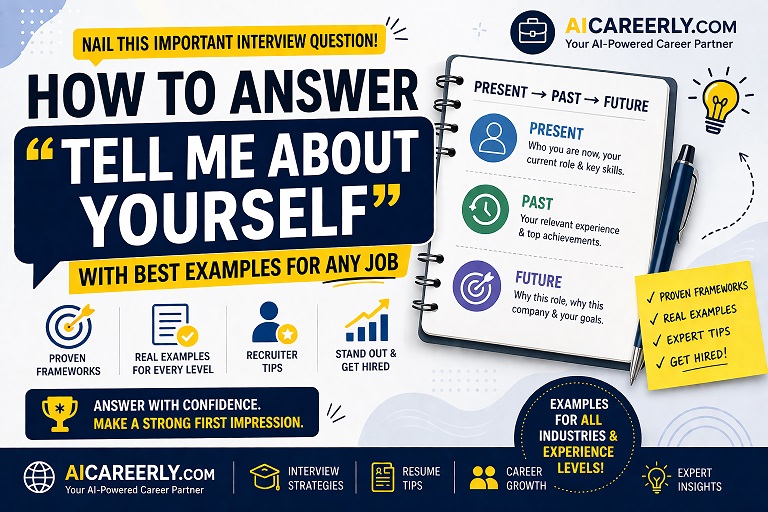
The Perfect Structure: Present → Past → Future
This is the gold standard framework.
1. Present (Who You Are Now)
- Current role or focus
- Key skills
- Area of expertise
Example:
“I’m currently a data analyst specializing in customer behavior and predictive modeling…”
2. Past (What You’ve Done)
- Relevant experience
- Achievements
- Measurable results
Example:
“In my previous role, I improved conversion rates by 25% through data-driven insights…”
3. Future (Why This Role)
- Why this company
- Why this position
- Career direction
Example:
“I’m now looking to apply these skills in a larger, data-driven organization like yours…”
Notion vs ChatGPT for Productivity: Which One Should You Use? (2026 Guide)
Alternative Frameworks
STAR Method (Situation, Task, Action, Result)
Best for structured storytelling.
Elevator Pitch Format
- 30–60 seconds
- High-impact summary
- Ideal for early-stage interviews
Storytelling Approach
Narrative-driven:
- Problem → Action → Outcome
- More engaging for senior roles
Step-by-Step Method to Craft Your Answer
1. Analyze the Job Description
Identify:
- Key responsibilities
- Required skills
- Keywords
2. Identify Matching Skills
Map your experience directly to the role.
3. Select Relevant Experience
Only include what strengthens your candidacy.
4. Structure Your Answer
Use Present → Past → Future.
5. Add Measurable Achievements
Numbers increase credibility:
- “Increased revenue by 30%”
- “Reduced costs by 15%”
6. Practice and Refine
Your answer should sound:
- Natural
- Confident
- Precise
50 Most Common Job Interview Questions (With AI-Generated Answers)
Examples for Every Job Type (Core Section)
🔹 Entry-Level Candidates
Example 1 (Fresh Graduate)
“I recently graduated with a degree in business administration, where I focused on marketing and data analysis. During my studies, I completed internships where I helped improve social media engagement by 40%. I’m now looking to start my career in a role where I can apply these analytical and creative skills to drive measurable results.”
Why it works:
- Focuses on skills, not lack of experience
- Includes measurable impact
- Shows direction
Example 2 (Student)
“I’m currently a final-year computer science student with strong interests in software development and AI. I’ve worked on several projects, including a machine learning model that predicts user behavior. I’m looking to transition into a full-time developer role where I can continue building scalable applications.”
🔹 Mid-Level Professionals
Software Engineer
“I’m a software engineer with five years of experience building scalable web applications. In my current role, I led a team that reduced system downtime by 35%. Previously, I worked on backend systems handling millions of users. I’m now looking to join a company where I can contribute to high-impact, large-scale systems.”
Marketing Professional
“I’m a digital marketer specializing in performance campaigns and SEO. In my current role, I increased organic traffic by 60% within a year. I’ve worked across multiple industries, optimizing campaigns for ROI. I’m now looking to bring this growth-focused approach to a company with a strong digital presence.”
Data Analyst
“I’m a data analyst with expertise in SQL, Python, and data visualization. I’ve helped organizations improve decision-making by building dashboards that reduced reporting time by 50%. I’m particularly interested in roles where data can directly influence business strategy.”
🔹 Senior-Level Candidates
Manager
“I’m a project manager with over 10 years of experience leading cross-functional teams. I’ve successfully delivered projects worth over $5M, consistently on time and under budget. I’m now looking to take on a strategic leadership role where I can drive organizational growth.”
Executive
“I’m a senior executive with a track record of scaling businesses and leading transformation initiatives. In my last role, I increased revenue by 40% over three years. I’m now focused on opportunities where I can lead large-scale innovation and growth.”
🔹 Career Switchers
“I started my career in finance, where I developed strong analytical skills. Over time, I became interested in data science and completed several certifications while working. I’ve since built projects involving machine learning and data analysis, and I’m now transitioning into a full-time data science role.”
🔹 No Experience Candidates
“I’m currently developing skills in digital marketing through online courses and personal projects. I’ve managed social media accounts where I increased engagement significantly. I’m eager to apply these skills in a professional environment and continue learning.”
🔹 AI / Tech Jobs
“I’m an AI-focused software engineer specializing in machine learning and automation. I’ve built models that improved prediction accuracy by 20% and deployed scalable solutions. I’m particularly interested in applying AI to real-world business problems.”
🔹 Remote Jobs
“I’m a remote-ready professional with experience collaborating across distributed teams. I’ve successfully managed projects across multiple time zones and use tools like Slack and Notion to stay organized. I’m looking for a role where I can continue delivering results in a remote environment.”
Examples for Different Countries (Global Focus)
US
- Direct and results-focused
- Emphasis on achievements
UK
- Slightly more formal
- Balanced tone
Canada
- Collaborative tone
- Emphasis on adaptability
Europe
- Professional and structured
- Less self-promotion, more credibility
Top AI Tools to Find Jobs Faster in 2026 (Complete Guide for Job Seekers)
How to Use AI to Craft the Perfect Answer
You can use tools like ChatGPT to refine your answer.
Copy-Paste Prompts:
- “Rewrite my answer for a software engineering role with stronger impact.”
- “Make my answer more concise and professional.”
- “Evaluate my answer like a hiring manager and suggest improvements.”
- “Add measurable achievements to this answer.”
Tailoring Your Answer for Any Job
- Mirror keywords from the job description
- Align with company goals
- Adjust tone based on industry
Ideal Answer Length
- 30 seconds → Screening interviews
- 60 seconds → Standard interviews
- 90 seconds → Senior roles
Delivery Tips
- Maintain eye contact
- Speak clearly and confidently
- Avoid filler words (“um,” “like”)
- Use controlled pacing
Advanced Strategies
Storytelling
Make your answer memorable:
- Problem → Action → Result
Psychological Triggers
- Confidence
- Clarity
- Relevance
Stand Out
- Use metrics
- Show impact
- Be specific
What NOT to Say
- Personal life details
- Salary expectations
- Negative past experiences
- Irrelevant history
Practice Exercises
- Record yourself
- Do mock interviews
- Use AI feedback tools
Top AI Skills Companies Are Hiring for in 2026 (High-Paying Guide)
Before vs After Example
Weak Answer
“I’ve worked in marketing for a few years and did different tasks…”
Strong Answer
“I’m a digital marketer with three years of experience specializing in SEO and paid campaigns. In my current role, I increased organic traffic by 50% within six months…”
Improvement:
- Clear structure
- Measurable results
- Strong positioning
Future of Interviews (AI + Hiring Trends)
- AI screening interviews are increasing
- Automated evaluation tools analyze communication
- Soft skills are becoming more critical
Conclusion
Mastering your “tell me about yourself interview answer” is not optional, it’s essential.
This single response:
- Shapes first impressions
- Defines your narrative
- Influences hiring decisions
The candidates who succeed are not necessarily the most qualified, they are the most prepared and strategic.
Start crafting your answer today:
- Use the frameworks
- Practice consistently
- Customize for every role
Your next interview outcome may depend on it.
Frequently Asked Questions (FAQs)
1. What is the best way to answer “Tell me about yourself” in an interview?
The most effective approach is the Present → Past → Future structure. Start with your current role or skills, highlight relevant past achievements, and finish by explaining why you’re interested in this specific role. This keeps your answer focused, logical, and aligned with what hiring managers want.
2. How long should my answer be?
Your answer should typically be between 60–90 seconds. For screening interviews, aim closer to 30–60 seconds. For senior roles, you can extend slightly, but avoid exceeding two minutes to maintain attention and clarity.
3. Should I talk about my personal life?
No. Avoid discussing personal details like family, hobbies (unless directly relevant), or background unrelated to the job. Focus strictly on your professional story and value.
4. Is it okay to repeat my resume?
Not exactly. Your answer should expand on your resume, not repeat it. Add context, highlight key achievements, and connect your experience directly to the role you’re applying for.
5. What if I have no work experience?
Focus on:
- Academic projects
- Internships
- Certifications
- Transferable skills
Even without formal experience, you can still present a strong skills-based narrative that shows potential and motivation.
6. How do I tailor my answer for different jobs?
Carefully review the job description and:
- Identify key skills and keywords
- Highlight matching experience
- Align your goals with the company’s needs
Customization is critical for a strong “tell me about yourself interview answer.”
7. Can I memorize my answer?
You should practice but not memorize word-for-word. A scripted answer can sound robotic. Instead, understand your structure and key points so your delivery remains natural and confident.
8. What are the biggest mistakes to avoid?
Common mistakes include:
- Rambling without structure
- Being too vague
- Talking too long
- Including irrelevant details
- Failing to show measurable impact
Avoid these to ensure a strong first impression.
9. How can I make my answer stand out?
To stand out:
- Use specific achievements with numbers
- Show clear career direction
- Demonstrate confidence and clarity
- Keep your answer relevant and concise
A strong answer is not just informative—it’s memorable and strategic.
10. Can I use AI tools to improve my answer?
Yes. AI tools can help you:
- Refine wording
- Add measurable impact
- Improve clarity and tone
- Simulate recruiter feedback
Use prompts like:
- “Improve this answer for a job interview”
- “Make this answer more concise and impactful”
This can significantly enhance your preparation.