Introduction
AI hiring is no longer limited to big tech, it’s now a global, cross-industry race for talent. From startups to Fortune 500 companies, organizations are aggressively integrating AI into their operations to gain a competitive edge.
The problem? There aren’t enough skilled professionals to meet demand.
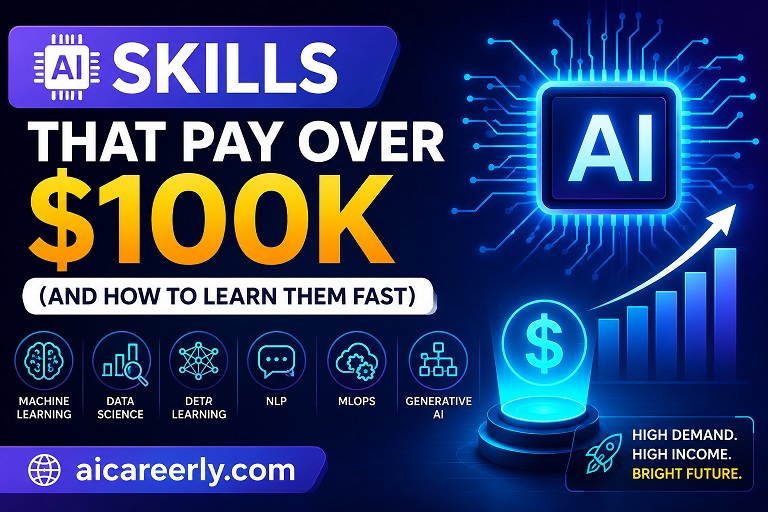
This talent shortage is pushing salaries higher and creating one of the most lucrative skill markets in modern history. Roles in AI, machine learning, and data science consistently rank among the highest-paying jobs globally, often exceeding $120,000–$200,000+ annually depending on specialization.
If you’re looking for a high-ROI skillset in 2026, AI is one of the strongest bets you can make.
How to Use AI to Get a Job Faster in 2026
.
Why AI Skills Are in High Demand
📈 1. Rapid AI Adoption Across Industries
AI is now core infrastructure in:
- Tech (SaaS, automation tools)
- Healthcare (diagnostics, drug discovery)
- Finance (fraud detection, trading algorithms)
- E-commerce (recommendation engines)
⚙️ 2. Automation & Productivity Gains
Companies are using AI to:
- Reduce operational costs
- Automate repetitive workflows
- Enhance decision-making
🧠 3. Talent Shortage
There are significantly more AI job openings than qualified candidates, making AI skills extremely valuable and future-proof.
.
Top AI Skills Companies Are Hiring For
🔹 1. Machine Learning
What it is: Algorithms that learn patterns from data to make predictions.
Why it matters: Core foundation of most AI systems.
Applications:
- Fraud detection
- Recommendation systems
- Predictive analytics
Salary impact: $120K–$180K+
Tools: Scikit-learn, TensorFlow, PyTorch
How to learn:
- Start with linear regression & classification
- Take ML courses (Coursera, Fast.ai)
- Build projects like spam classifiers
.
🔹 2. Deep Learning
What it is: Neural networks that model complex patterns.
Why companies need it: Powers advanced AI like image recognition and speech systems.
Applications:
- Autonomous driving
- Voice assistants
- Medical imaging
Salary impact: $140K–$200K+
Tools: PyTorch, TensorFlow, Keras
How to learn:
- Learn neural network basics
- Train CNNs and RNNs
- Work on real datasets (e.g., image classification)
How to Use AI to Prepare for Job Interviews in 2026 (Step-by-Step Guide)
.
🔹 3. Natural Language Processing (NLP)
What it is: AI that understands and generates human language.
Why it matters: Core of chatbots, search engines, and AI assistants.
Applications:
- Chatbots
- Sentiment analysis
- AI writing tools
Salary impact: $130K–$190K+
Tools: Hugging Face Transformers, spaCy, NLTK
How to learn:
- Study text preprocessing
- Build chatbot or text classifier
- Fine-tune language models
.
🔹 4. Computer Vision
What it is: AI that interprets images and videos.
Why companies need it: Used in security, healthcare, and automation.
Applications:
- Facial recognition
- Medical scans
- Retail analytics
Salary impact: $130K–$180K+
Tools: OpenCV, YOLO, TensorFlow
How to learn:
- Learn image processing basics
- Train object detection models
- Build projects like face detection apps
.
🔹 5. Prompt Engineering
What it is: Crafting effective prompts for AI models.
Why it matters: Critical for maximizing LLM performance.
Applications:
- AI content generation
- Automation workflows
- Chatbot optimization
Salary impact: $90K–$160K+
Tools: ChatGPT, Claude, LangChain
How to learn:
- Experiment with prompts
- Learn prompt frameworks (few-shot, chain-of-thought)
- Build AI automation workflows
.
🔹 6. MLOps (Machine Learning Operations)
What it is: Managing the lifecycle of ML models in production.
Why companies need it: Models must be scalable and reliable.
Applications:
- Model deployment pipelines
- Monitoring AI performance
- Continuous training
Salary impact: $140K–$200K+
Tools: Docker, Kubernetes, MLflow, AWS SageMaker
How to learn:
- Learn DevOps basics
- Deploy ML models via APIs
- Practice CI/CD pipelines
How to Learn AI in 2026: Complete Beginner Roadmap (Step-by-Step)
.
🔹 7. Data Analysis & Visualization
What it is: Extracting insights from data.
Why it matters: AI is useless without good data.
Applications:
- Business intelligence
- Decision-making dashboards
- Data storytelling
Salary impact: $80K–$130K+
Tools: Pandas, Tableau, Power BI
How to learn:
- Master Excel & SQL
- Learn Python for data
- Build dashboards
.
🔹 8. Python for AI
What it is: Primary programming language for AI.
Why companies need it: Almost all AI tools rely on Python.
Applications:
- Model development
- Automation scripts
- Data processing
Salary impact: Foundational skill (affects all roles)
Tools: NumPy, Pandas, TensorFlow
How to learn:
- Learn Python basics
- Practice data manipulation
- Build small AI projects
.
🔹 9. Generative AI (LLMs, Diffusion Models)
What it is: AI that creates content (text, images, code).
Why it matters: Fastest-growing AI sector.
Applications:
- AI writing tools
- Image generation
- Code assistants
Salary impact: $150K–$220K+
Tools: OpenAI API, Stable Diffusion, LangChain
How to learn:
- Study LLM architecture basics
- Build AI apps (chatbots, generators)
- Fine-tune models
Best AI Resume Templates for 2026 (Free + ATS-Friendly Downloads)
.
🔹 10. AI Model Deployment
What it is: Turning models into usable applications.
Why companies need it: AI must be accessible to users.
Applications:
- APIs
- SaaS AI tools
- Real-time systems
Salary impact: $120K–$180K+
Tools: Flask, FastAPI, Docker
How to learn:
- Build APIs for ML models
- Deploy apps on cloud platforms
- Practice scaling systems
.
🔹 11. Reinforcement Learning
What it is: AI that learns via rewards and actions.
Applications:
- Robotics
- Game AI
- Trading systems
Salary impact: $140K–$200K+
How to learn:
- Study RL basics
- Implement Q-learning
- Build simulation projects
.
🔹 12. AI Ethics & Governance
What it is: Responsible AI development.
Why it matters: Increasing regulations globally.
Applications:
- Bias detection
- Compliance
- Risk management
Salary impact: $100K–$170K+
How to learn:
- Study AI policy
- Learn fairness metrics
- Analyze case studies
Best AI Productivity Tools for Job Seekers in 2026 (Tested & Ranked)
.
📊 AI Skills Salary Comparison
| Skill | Avg Salary | Demand Level | Difficulty |
|---|---|---|---|
| Machine Learning | $120K–$180K | Very High | Medium |
| Deep Learning | $140K–$200K | High | High |
| NLP | $130K–$190K | Very High | High |
| Computer Vision | $130K–$180K | High | High |
| Prompt Engineering | $90K–$160K | Exploding | Low–Medium |
| MLOps | $140K–$200K | Very High | High |
| Data Analysis | $80K–$130K | Very High | Low |
| Python for AI | Foundational | Essential | Low |
| Generative AI | $150K–$220K | Exploding | Medium |
| Model Deployment | $120K–$180K | High | Medium |
🧭 How to Choose the Right AI Skill
Based on Career Goals
- Data-focused: Data Analysis, ML
- Engineering: MLOps, Deployment
- Creative AI: Generative AI, Prompt Engineering
Based on Experience
- Beginner: Python, Data Analysis, Prompt Engineering
- Intermediate: Machine Learning, NLP
- Advanced: MLOps, Deep Learning
Based on Time to Learn
- Quick ROI: Prompt Engineering, Data Analysis
- Long-term: Deep Learning, MLOps
.
🚀 How to Learn AI Skills Fast
1. Platforms:
- Coursera
- Udemy
- Fast.ai
2. Proven Strategy:
- Learn fundamentals
- Build projects (portfolio is critical)
- Upload to GitHub
- Solve real-world problems
3. Example Projects:
- Chatbot using NLP
- Image classifier
- AI resume screener
.
💡 High-Income Strategy (CRITICAL)
Combine Skills
- NLP + MLOps = High-paying AI Engineer
- Generative AI + Prompt Engineering = AI Automation Specialist
Specialize in Niches
- LLMs
- AI agents
- Automation systems
Monetization Paths
- Freelancing (Upwork, Fiverr)
- Remote jobs
- Build AI SaaS tools
.
⚠️ Common Mistakes to Avoid
- Learning too many skills at once
- Not building real projects
- Ignoring fundamentals
- Following hype instead of demand
Best AI Resume Builders in 2026 (Tested & Ranked)
.
Future of AI Skills (2026–2030)
📈 Skills That Will Grow
- Generative AI
- AI automation
- MLOps
📉 Skills That May Decline
- Basic data entry roles
- Manual analysis jobs
🚀 Emerging Trends
- AI agents
- Autonomous systems
- Human-AI collaboration tools
.
Conclusion
AI is no longer optional, it’s a career accelerator. The fastest way to break into high-paying tech roles today is to focus on top AI skills that companies are actively hiring for. Instead of spreading yourself thin, choose a clear path, build real projects, and stack complementary skills. The opportunity window is wide open, but it won’t stay that way forever. Start building your AI skillset today, and position yourself at the center of the next technological wave.
.
❓ Frequently Asked Questions (FAQs)
1. What are the top AI skills to learn in 2026?
The top AI skills include machine learning, deep learning, natural language processing (NLP), computer vision, prompt engineering, MLOps, generative AI, and AI model deployment. These are considered the most in-demand AI skills in 2026 due to rapid industry adoption.
2. Which AI skill is best for beginners?
For beginners, starting with Python for AI, data analysis, and prompt engineering is the most effective path. These skills have a lower barrier to entry and provide a strong foundation for more advanced AI topics.
3. How long does it take to learn AI skills?
It depends on the skill level:
- Beginner basics: 2–3 months
- Intermediate (machine learning, NLP): 4–8 months
- Advanced (deep learning, MLOps): 8–12+ months
Consistency and project-based learning significantly speed up progress.
4. Do I need a degree to learn AI skills?
No. Many professionals enter AI careers without a formal degree. What matters most is practical experience, a strong portfolio, and demonstrable skills in real-world projects.
5. Which AI skills pay the highest salaries?
High paying AI skills include:
- Generative AI
- MLOps
- Deep Learning
- NLP
These roles often command salaries above $140K due to their complexity and demand.
6. Is Python necessary for AI careers?
Yes, Python is the most widely used programming language in AI. It’s essential for machine learning, data analysis, automation, and model deployment.
7. What is the difference between machine learning and deep learning?
Machine learning involves algorithms that learn from data, while deep learning is a subset of machine learning that uses neural networks to handle more complex tasks like image and speech recognition.
8. Can I get a job with only prompt engineering skills?
Yes, but it’s more effective when combined with other skills like generative AI or automation. Prompt engineering alone is growing fast, but hybrid skillsets offer better job security and income potential.
9. What projects should I build to get hired in AI?
Strong portfolio projects include:
- Chatbots using NLP
- Recommendation systems
- Image classifiers
- AI automation tools
Projects that solve real-world problems stand out the most to recruiters.
10. What are the most future-proof AI skills?
Future-proof AI skills include generative AI, MLOps, AI model deployment, and AI ethics. These areas are expected to grow significantly between 2026 and 2030 due to increasing reliance on AI systems.