Introduction: Why Most Candidates Fail Interviews (Even When They’re Qualified)
Many job seekers assume that strong qualifications automatically guarantee interview success. In reality, hiring decisions are often influenced less by what you know and more by how clearly, confidently, and strategically you communicate it.
A major reason candidates fail interviews is lack of structured preparation. Answers are often too vague, overly technical, unfocused, or disconnected from the job role. Even highly skilled professionals struggle to translate their experience into compelling narratives that hiring managers can evaluate quickly.
This is where preparation becomes a competitive advantage. Modern hiring systems now prioritize communication clarity, behavioral evidence, and role alignment.
AI tools have also changed how candidates prepare. With AI-generated responses, mock interviews, and structured frameworks, candidates can now practice realistic interview scenarios and refine their answers before the real interview.
This guide provides 50 most common job interview questions with AI-generated sample answers, designed to help you perform like a top 1% candidate in any interview setting.
Top AI Mock Interview Tools to Practice & Get Hired Faster in 2026
How to Use AI to Prepare for Interviews
AI has become a powerful tool for job interview preparation, especially for global candidates competing in remote and international hiring markets.
How AI Improves Interview Performance
Answer Structure: AI helps organize answers using frameworks like STAR (Situation, Task, Action, Result)
Clarity: Removes unnecessary detail and improves message precision
Relevance: Aligns answers with job descriptions and employer expectations
Confidence Building: Enables unlimited practice without judgment
Recommended AI Tools
ChatGPT (mock interviews + answer refinement)
AI interview simulators (e.g., Interview Warmup, HireVue practice tools)
Career coaching AI platforms
Copy-Paste AI Prompts for Practice
“Act as a hiring manager for a [Job Title] role and interview me with 10 questions.”
“Improve my answer to this interview question and make it more structured using STAR method.”
“Simulate a behavioral interview and evaluate my responses critically.”
“Generate strong sample answers for a senior [role] interview.”
How to Use AI to Prepare for Job Interviews in 2026 (Step-by-Step Guide)
50 Most Common Job Interview Questions (With AI-Generated Answers)
A. General Questions (1–10)
1. Tell me about yourself
Answer: I am a [profession] with X years of experience in [industry]. I specialize in [skill area], with a strong track record of delivering results such as [achievement]. I am currently focused on growing in roles that involve [career goal aligned to job].
2. What are your strengths?
Answer: My key strengths include problem-solving, adaptability, and communication. For example, I improved [process/project], which resulted in [measurable outcome].
3. What is your weakness?
Answer: I previously struggled with delegation. However, I improved by using structured task management tools and learning to trust team members, which increased productivity.
4. Why do you want this job?
Answer: This role aligns with my expertise in [skill] and my long-term goal of working in [industry direction]. I am particularly interested in your company’s focus on [value or project].
5. Where do you see yourself in 5 years?
Answer: I aim to grow into a senior or leadership role where I can contribute to strategic decision-making and mentor junior professionals.
6. Why should we hire you?
Answer: I bring a combination of technical expertise, problem-solving ability, and proven results. I can contribute immediately while also growing with the organization.
7. What motivates you?
Answer: I am motivated by solving complex problems, learning new technologies, and delivering measurable business impact.
8. What are your salary expectations?
Answer: Based on market research and my experience level, I am looking for a competitive salary aligned with industry standards, but I am open to discussion.
9. What do you know about our company?
Answer: Your company is known for [industry position, product, innovation]. I also admire your work in [specific project or value].
10. Do you prefer working alone or in a team?
Answer: I am comfortable with both. I enjoy collaboration for innovation but also work independently when required for focused execution.
B. Behavioral Questions (11–25)
11. Tell me about a time you solved a difficult problem
Answer (STAR): I identified a system inefficiency (Situation), was responsible for improving it (Task), implemented automation (Action), and reduced processing time by 40% (Result).
12. Describe a conflict at work
Answer: I had a disagreement with a colleague on project priorities. I initiated a discussion, clarified objectives, and we aligned on a shared plan that improved delivery speed.
13. How do you handle stress?
Answer: I prioritize tasks, break work into smaller steps, and focus on high-impact actions. This helps me maintain performance under pressure.
14. Give an example of leadership
Answer: I led a small project team where I coordinated tasks, ensured deadlines were met, and delivered the project 2 weeks early.
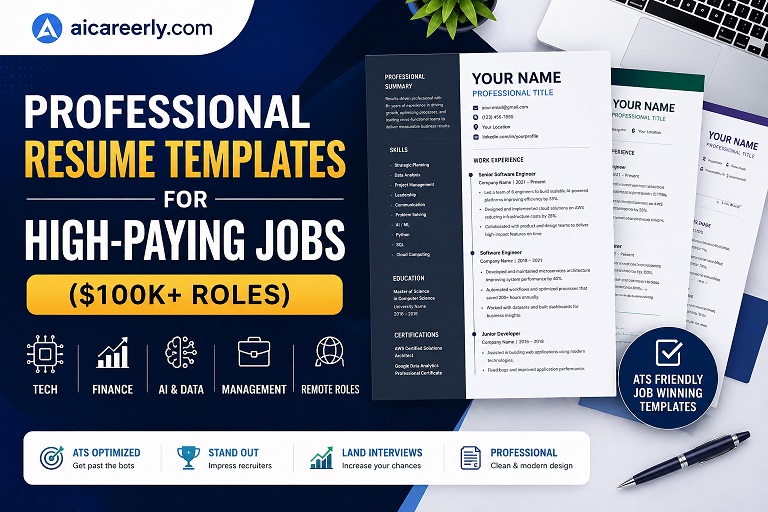
Best AI Resume Templates for 2026 (Free + ATS-Friendly Downloads)
15. Tell me about failure
Answer: I once missed a project deadline due to poor estimation. I learned to use better planning tools and now always build buffer time.
16. How do you handle feedback?
Answer: I view feedback as an improvement tool. I analyze it, ask clarifying questions, and apply changes immediately.
17. Describe a time you worked in a team
Answer: I collaborated with a cross-functional team to deliver a product feature that improved user engagement by 25%.
18. Tell me about a challenge at work
Answer: We faced tight deadlines. I reorganized tasks and prioritized critical deliverables, ensuring on-time completion.
19. How do you prioritize tasks?
Answer: I use impact vs urgency analysis to focus on high-value tasks first.
20. Have you ever made a mistake?
Answer: Yes, I once miscommunicated requirements. I corrected it quickly and introduced a verification step to prevent recurrence.
C. Technical / Skill-Based Questions (26–35)
26. Explain your technical expertise
Answer: I specialize in [skill], with hands-on experience in tools like [tech stack]. I have applied them in real-world projects.
27. Describe a technical project
Answer: I built [project], which solved [problem], using [tools], resulting in [impact].
28. How do you debug issues?
Answer: I isolate the problem, test hypotheses, and use logs or debugging tools systematically.
D. Situational Questions (36–45)
36. What would you do if a deadline is missed?
Answer: I would immediately communicate, assess impact, and adjust priorities to minimize delay.
37. How would you handle multiple deadlines?
Answer: I would rank tasks based on urgency and business impact.
38. What if you disagree with your manager?
Answer: I would present data-backed reasoning respectfully and align with final decision.
E. HR / Closing Questions (46–50)
46. Do you have any questions for us?
Answer: Yes, I’d like to know about team structure, success metrics, and growth opportunities.
47. Why are you leaving your current job?
Answer: I am seeking growth opportunities aligned with my long-term career goals.
48. What makes you unique?
Answer: My ability to combine technical skill with structured problem-solving.
49. When can you start?
Answer: I can start after completing my notice period or immediately if required.
50. Why are you the best fit?
Answer: My skills, experience, and mindset align closely with this role’s requirements, allowing me to contribute effectively from day one.
How AI Helps You Improve Interview Performance
AI enables candidates to:
* Simulate real interview environments
* Get instant feedback on weak answers
* Practice unlimited mock interviews
* Refine tone, clarity, and structure
This creates a data-driven preparation system rather than guesswork.
Best AI Prompts for Interview Practice
“Act as a strict hiring manager and interview me for a senior role.”
“Rewrite my answer to sound more confident and structured.”
“Score my answer from 1–10 and suggest improvements.”
“Generate STAR method answers for behavioral questions in [job role].”
STAR Method Breakdown
Situation: Context of the challenge
Task: Your responsibility
Action: What you did
Result: Outcome achieved
Example: Before: “I improved team performance.”
After: “In my previous role, I identified inefficiencies in team workflow (Situation), was responsible for improving productivity (Task), introduced automation tools (Action), resulting in a 30% performance increase (Result).”
Free Cover Letter Templates That Actually Get Interviews (2026 Guide)
Advanced Interview Strategies
Align answers with job description keywords
Use measurable results in every response
Practice timed responses (60–90 seconds)
Focus on clarity over complexity
Always prepare 2–3 impact stories
Common Mistakes to Avoid
Memorizing answers word-for-word
Giving vague or generic responses
Ignoring job role context
Over-explaining answers
Lack of structured storytelling
Future of AI in Interviews (2026+)
Hiring is rapidly evolving with AI-driven systems:
* AI screening interviews
* Automated scoring systems
* Video interview analysis (tone, confidence, behavior)
* Skill-based hiring replacing CV-first selection
Candidates who master structured AI-assisted preparation will have a strong advantage.
Conclusion
Success in interviews is no longer just about experience, it is about how effectively you communicate that experience. Using structured frameworks, AI-generated responses, and consistent practice, you can significantly improve your interview performance. Before your next interview, practice all 50 questions, refine your answers using AI, and focus on clarity, structure, and impact. Preparation is the real competitive advantage.
Frequently Asked Questions (FAQs)
1. What are the most common job interview questions?
They include “Tell me about yourself,” strengths and weaknesses, and behavioral problem-solving questions.
2. How do I answer interview questions effectively?
Use structured frameworks like STAR and include real examples.
3. Can AI help with interview preparation?
Yes, AI can simulate interviews, refine answers, and provide structured feedback.
4. What is the STAR method?
A framework: Situation, Task, Action, Result used for behavioral answers.
5. How long should answers be?
Typically 45–90 seconds per answer.
6. What mistakes should I avoid?
Avoid vague answers, memorization, and lack of structure.
7. How do I prepare for behavioral questions?
Prepare 5–7 real examples using STAR format.
8. How do I answer weakness questions?
Mention a real weakness and show improvement.
9. How do I stand out in interviews?
Use structured, measurable, and role-aligned answers.
10. Should I use AI answers directly?
Use AI for practice, but always personalize with real experience.