The Moment Everything Changes
At 1:47 AM, Lina refreshed her inbox one last time before giving up for the night.
“Interview Invitation – Machine Learning Engineer (Montreal, Visa Sponsored)”
Three months earlier, she had nearly quit her job search entirely. She had the skills. She had the degree. But like thousands of global candidates, she was approaching Canada’s AI market the wrong way, sending generic applications into one of the most competitive talent pipelines in the world.
What changed wasn’t luck. It was strategy. She stopped thinking of Canada as “just another job market” and started understanding it as what it truly is in 2026:
A structured AI ecosystem with clear entry points for those who know how to navigate it.
This guide is your roadmap to doing exactly that.
.
The Canadian AI Boom in 2026: Why Opportunity Is Peaking Now
The year 2026 marks a structural shift in Canada’s economy. Artificial intelligence is no longer experimental, it is now embedded across industries, from fintech to healthcare and even natural resources. At the center of this transformation is the Pan-Canadian Artificial Intelligence Strategy, a federal initiative that has turned Canada into a global AI supercluster.
This ecosystem is anchored by three major institutions:
- The Vector Institute in Toronto
- Mila in Montreal
- Alberta Machine Intelligence Institute (Amii) in Edmonton
These are not just research centers, they are talent pipelines feeding directly into industry.
What this means for you:
- Companies are no longer hiring generalists.
- They are hiring specialized AI professionals who can build, deploy, and scale systems.
How to Get Visa Sponsorship Jobs in 2026 (Step-by-Step AI Strategy)
.
What AI Jobs Actually Look Like in Canada Today
Forget outdated job descriptions. In 2026, Canadian employers are hiring for production-grade AI roles, not academic prototypes.
High-Demand Roles
The strongest hiring demand is concentrated in:
- Machine Learning Engineers
- Data Scientists
- MLOps Engineers
- Generative AI Specialists
- AI Research Engineers
- AI Product Managers
But there’s an important nuance; The highest demand is for professionals who can bridge research and production.
.
The Technical Bar: What You Must Know to Compete
The hiring standard has evolved significantly. Employers are no longer impressed by isolated notebooks or basic models. They want engineers who understand the full lifecycle of AI systems.
Core Technical Requirements
A competitive candidate in 2026 typically demonstrates:
1. Distributed Computing
Handling large-scale data pipelines using frameworks like Spark or Ray.
2. MLOps & Deployment
Experience with:
- Kubernetes
- Kubeflow
- Cloud platforms (AWS, Azure, GCP)
3. Advanced AI Architectures
Strong understanding of:
- Transformer models
- Diffusion models
- Retrieval-Augmented Generation (RAG)
4. Ethics and Compliance
With the introduction of the Artificial Intelligence and Data Act (AIDA), companies now prioritize:
- Bias mitigation
- Model explainability
- Responsible AI practices
Candidates with compliance knowledge often command 15–20% higher salaries.
.
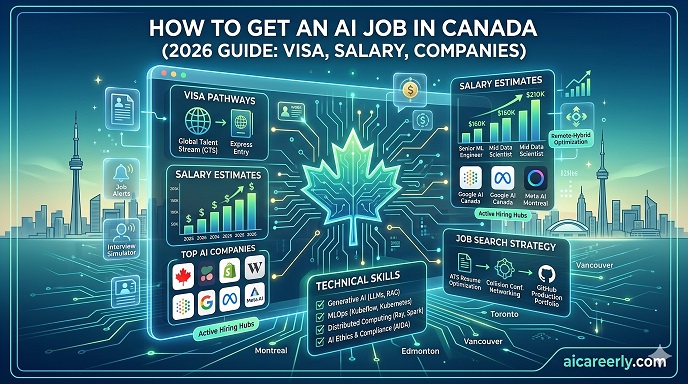
Visa Pathways: How to Legally Work in Canada as an AI Professional
For most international candidates, immigration is the biggest barrier, but Canada has effectively removed much of that friction.
a. Global Talent Stream (Fastest Route)
The most powerful pathway is the Global Talent Stream (GTS).
Key advantages:
- Work permit processing in ~10 business days
- No traditional LMIA delays
- Designed specifically for tech talent
This is how most AI professionals enter Canada quickly.
.
b. Express Entry (Permanent Residency Path)
For long-term relocation, Express Entry remains the dominant system.
AI professionals benefit from:
- High CRS scores due to education and skills
- STEM-specific draws introduced in recent immigration targets
- Faster invitations for in-demand occupations
In many cases, AI expertise alone can significantly boost your chances.
.
c. Provincial Nominee Programs (PNPs)
Certain provinces actively recruit AI talent:
- Ontario (Toronto, Waterloo)
- Quebec (Montreal)
- British Columbia (Vancouver)
- Alberta (Calgary)
Each province aligns its immigration with local labor shortages.
Best Countries Sponsoring AI Talent in 2026 (Salary + Visa + Demand)
.
Salary Reality in 2026: What You Can Expect
AI compensation in Canada has surged due to global competition for talent.
Current Salary Benchmarks
- Mid-level Data Scientist: $115,000 – $150,000 CAD
- Senior Machine Learning Engineer: $160,000 – $210,000 CAD
- Specialized AI roles (LLMs, MLOps): Can exceed $220,000+ CAD
Many roles also include:
- Equity packages
- Performance bonuses
- Signing incentives
.
Cost of Living Trade-Off
High salaries come with geographic realities.
Expensive Cities
- Toronto
- Vancouver
These cities offer the highest pay—but also the highest housing costs.
Emerging Alternatives
- Waterloo
- Calgary
- Atlantic Canada
Among these, Calgary stands out as a high-growth AI hub with lower taxes and housing costs.
A growing trend in 2026 is hybrid-remote work, allowing professionals to live in affordable regions while working for major companies.
.
Top AI Companies Hiring in Canada (2026)
Canada’s AI ecosystem is split between global tech giants and high-growth startups.
1. Global AI Leaders
- Google AI
- Meta
- Microsoft Research
These companies have built large research labs to access Canadian talent pipelines.
2. Canadian AI Powerhouses
- Cohere – Leading LLM company competing globally
- Shopify – AI integrated across its ecosystem
- Wealthsimple – Heavy AI use in financial automation
AI in Healthcare & Deep Tech
- Deep Genomics – Using AI to develop therapies
This sector often offers more stability and mission-driven work compared to consumer tech.
.
How to Build a Portfolio That Gets You Hired
This is where most candidates fail. A strong portfolio in 2026 must demonstrate production readiness, not just experimentation.
What Recruiters Expect
- End-to-end pipelines (data → model → deployment)
- Real-world use cases (not toy datasets)
- Clean documentation
- Scalable architecture
High-Impact Project Ideas
Instead of generic projects, focus on:
- AI-powered recommendation systems
- RAG-based chatbot applications
- Fraud detection systems
- Real-time prediction APIs
Your portfolio should answer one question clearly: “Can this person ship AI systems in a real company?”
How to Learn AI in 2026: Complete Beginner Roadmap (Step-by-Step)
.
Resume Strategy: What Works in Canada
Your resume must align with Canadian hiring standards and ATS systems.
Key Principles
- Use a clean, reverse-chronological format
- Avoid graphics or complex designs
- Focus on measurable impact
Example Transformation
Instead of: “Improved model performance”
Write: “Reduced inference latency by 40% using TensorRT, saving $50,000/month in cloud costs”
Specificity is what gets interviews.
.
Networking: The Hidden Job Market Advantage
Canada’s job market relies heavily on referrals. Many AI roles are never publicly advertised.
Effective Networking Strategy
- Engage with professionals on LinkedIn
- Participate in AI communities
- Attend major conferences like Collision Conference
But here’s the key difference: Networking in Canada is relationship-driven, not transactional.
Focus on:
- Sharing insights
- Asking thoughtful questions
- Demonstrating expertise
.
The Real Timeline: How Long It Takes
Let’s set realistic expectations. A structured job search typically looks like:
- 1–2 months: Skill and portfolio alignment
- 1–3 months: Applications and interviews
- 2–4 weeks: Visa processing (GTS route)
Total: 3–6 months for most candidates
.
Common Mistakes That Kill Your Chances
Even strong candidates fail due to avoidable errors:
- Applying without a production-ready portfolio
- Ignoring Canadian resume standards
- Focusing only on big tech companies
- Not understanding visa pathways
- Sending generic applications
Fixing these alone can dramatically increase your success rate.
.
Final Insight: How to Position Yourself for Success
Canada in 2026 is not just hiring AI talent, it is competing globally for it. But the winners are not the most qualified on paper. They are the ones who:
- Align their skills with industry demand
- Understand immigration pathways
- Build real-world, deployable AI systems
- Integrate into the Canadian tech ecosystem
.
Your Action Plan
Start immediately:
- Build 2–3 production-grade AI projects
- Optimize your resume for Canadian ATS systems
- Target high-growth AI companies
- Apply strategically—not blindly
- Prepare for system design and ML interviews
Canada’s AI market is open but not forgiving. If you approach it strategically, you won’t just apply.
You’ll compete—and win—in one of the world’s most advanced AI ecosystems.
.