Artificial intelligence is reshaping the Australian job market faster than many experts predicted. From finance and healthcare to mining and cybersecurity, companies across the country are investing heavily in AI technologies. As a result, AI jobs in Australia 2026 are becoming some of the most sought-after roles in the tech industry.
The demand for AI professionals is rising due to rapid digital transformation, increased cloud adoption, and the growing use of generative AI tools. Australian businesses are not only hiring experienced engineers but also searching for data scientists, prompt engineers, AI consultants, and machine learning specialists.
For international professionals, students, and career changers, this creates major opportunities. Whether you want a high-paying AI engineering role, remote work flexibility, or visa-sponsored employment, Australia’s AI sector offers strong long-term potential.
How to Get Visa Sponsorship Jobs in the United Kingdom (Skilled Worker Route Explained)
Why AI Jobs Are Booming in Australia in 2026
The growth of AI careers Australia-wide is being driven by several important factors.
1. Strong Business Investment in AI
Australian companies are investing heavily in automation, analytics, and generative AI systems to improve productivity. Large enterprises and startups alike are integrating AI into customer service, software development, logistics, and marketing operations.
Industries rapidly adopting AI include:
- Healthcare
- Banking and fintech
- Retail and eCommerce
- Mining
- Education
- Cybersecurity
- Government services
2. Government Support and Digital Initiatives
Australia continues to expand its digital economy strategy, encouraging AI innovation and workforce development. Funding programs and research partnerships are helping universities and tech firms accelerate AI adoption.
3. Rapid Growth in Major Cities
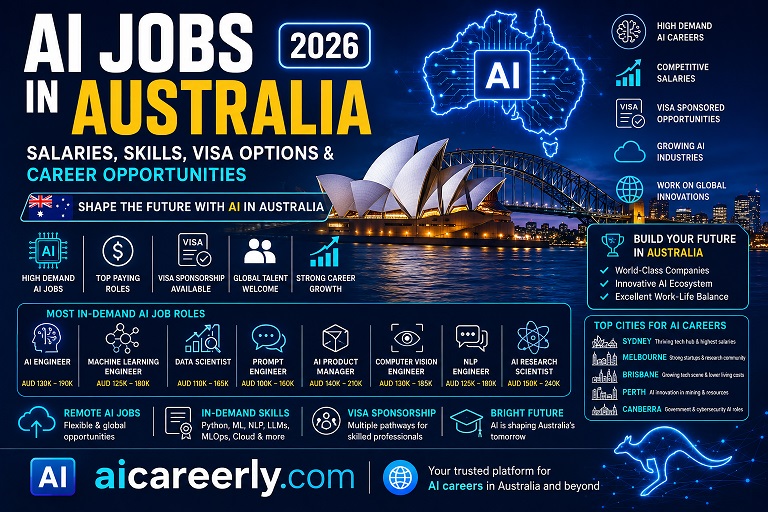
Cities such as Sydney, Melbourne, Brisbane, and Perth are emerging as strong AI hiring hubs. Tech startups, multinational companies, and research institutions are creating thousands of artificial intelligence jobs Australia-wide.
4. Demand for Generative AI Expertise
The rise of large language models (LLMs) and AI automation tools has significantly increased demand for professionals skilled in prompt engineering, AI deployment, and machine learning operations.
Most In-Demand AI Jobs in Australia
Below are some of the fastest-growing machine learning jobs Australia employers are actively hiring for in 2026.
1. AI Engineer
AI engineers design, build, and deploy intelligent systems for businesses.
Average Salary: AUD 130,000 – AUD 190,000
Required Skills:
- Python
- TensorFlow
- PyTorch
- APIs
- Cloud AI services
Experience Level: Mid to senior level
2. Machine Learning Engineer
Machine learning engineers create predictive models and scalable ML systems.
Average Salary: AUD 125,000 – AUD 180,000
Required Skills:
- Machine learning algorithms
- Data pipelines
- MLOps
- Python
- SQL
Experience Level: Mid level
3. Data Scientist
Data scientists analyze complex datasets and generate business insights.
Average Salary: AUD 110,000 – AUD 165,000
Required Skills:
- Statistics
- Data visualization
- Python
- Machine learning
- Communication
Experience Level: Entry to senior level
4. Prompt Engineer
Prompt engineering jobs Australia employers offer are growing rapidly due to generative AI adoption.
Average Salary: AUD 100,000 – AUD 160,000
Required Skills:
- LLM prompting
- AI workflows
- Research
- Testing and optimization
- Content automation
Experience Level: Entry to mid level
5. AI Product Manager
AI product managers oversee AI-powered products and coordinate technical teams.
Average Salary: AUD 140,000 – AUD 210,000
Required Skills:
- Product strategy
- AI systems understanding
- Agile workflows
- Stakeholder management
Experience Level: Senior level
6. AI Consultant
AI consultants help businesses adopt and scale AI solutions.
Average Salary: AUD 120,000 – AUD 190,000
Required Skills:
- AI strategy
- Business analysis
- Communication
- Technical understanding
Experience Level: Mid to senior level
7. Computer Vision Engineer
These professionals develop image recognition and video analysis systems.
Average Salary: AUD 130,000 – AUD 185,000
Required Skills:
- OpenCV
- Deep learning
- Computer vision models
- Python
Experience Level: Mid level
8. NLP Engineer
Natural Language Processing engineers work on chatbots, AI assistants, and language models.
Average Salary: AUD 125,000 – AUD 180,000
Required Skills:
- NLP frameworks
- LLMs
- Transformers
- Python
Experience Level: Mid to senior level
9. AI Research Scientist
Research scientists focus on advanced AI innovation and experimentation.
Average Salary: AUD 150,000 – AUD 240,000
Required Skills:
- Deep learning
- Research methods
- Mathematics
- Scientific publishing
Experience Level: Senior and PhD-level
10. Generative AI Specialist
Generative AI specialists help businesses implement AI content and automation systems.
Average Salary: AUD 120,000 – AUD 200,000
Required Skills:
- Generative AI platforms
- Prompt engineering
- Automation workflows
- AI ethics
Experience Level: Mid level
USA AI Jobs with H1B Sponsorship (Reality + Opportunities)
Top AI Skills Employers Want in 2026
The AI skills in demand Australia employers prioritize continue evolving quickly.
The most valuable technical skills include:
- Python programming
- TensorFlow
- PyTorch
- Large language models (LLMs)
- Prompt engineering
- Generative AI tools
- MLOps
- Cloud computing
- Data engineering
- AI governance and ethics
However, technical expertise alone is not enough.
Employers increasingly value soft skills such as:
- Problem-solving
- Communication
- Adaptability
- Team collaboration
- Critical thinking
Professionals who can explain complex AI concepts to non-technical stakeholders often stand out during hiring.
How to Get Visa Sponsorship Jobs in the United Kingdom (Skilled Worker Route Explained)
Best Cities in Australia for AI Jobs
1. Sydney
Sydney remains Australia’s largest tech employment hub.
Advantages:
- Highest concentration of AI companies
- Strong fintech sector
- Higher average salaries
Challenges:
- Competitive market
- Higher cost of living
2. Melbourne
Melbourne has a thriving startup ecosystem and strong research community.
Advantages:
- Strong innovation culture
- Growing AI startup scene
- Excellent universities
3. Brisbane
Brisbane is rapidly expanding its technology sector.
Advantages:
- Lower living costs
- Increasing enterprise AI adoption
- Emerging startup opportunities
4. Canberra
Canberra offers strong opportunities in government and cybersecurity AI.
Advantages:
- Public sector AI projects
- Defense technology roles
- Stable demand
5. Perth
Perth’s mining and resource industries are investing heavily in AI automation.
Advantages:
- Industrial AI growth
- Smart mining technologies
- Infrastructure projects
Visa Sponsored AI Jobs in Australia
Visa sponsored AI jobs Australia employers offer are attracting international talent due to ongoing tech skill shortages.
Common pathways include:
- Employer-sponsored visas
- Skilled migration programs
- Global talent programs
- Regional sponsorship opportunities
AI professionals are highly attractive to employers because many businesses struggle to fill advanced technical positions locally.
Tips for International Applicants
- Build a strong GitHub portfolio
- Gain cloud and AI certifications
- Tailor resumes to Australian hiring standards
- Apply through specialized job platforms
- Network with recruiters and AI communities
Candidates with experience in generative AI, cloud AI infrastructure, and machine learning operations often have stronger visa sponsorship opportunities.
Remote AI Jobs in Australia
Remote AI jobs Australia companies offer have increased significantly since hybrid work became mainstream.
Popular remote AI roles include:
- Prompt engineering
- AI content operations
- Machine learning engineering
- AI consulting
- Data science
Freelance AI opportunities are also growing on global platforms where Australian professionals work with international clients.
Many companies now prioritize skills and portfolio quality over physical office presence.
How to Start an AI Career in Australia
Breaking into the AI industry requires both technical learning and practical experience.
1. Learn Core AI Skills
Start with:
- Python
- Machine learning fundamentals
- Data analysis
- AI frameworks
2. Build Real Projects
Create:
- AI chatbots
- Recommendation systems
- Image recognition apps
- Generative AI workflows
3. Create a Portfolio
Use GitHub and portfolio websites to showcase your projects and technical abilities.
4. Gain Certifications
Popular areas include:
- Cloud AI
- Data science
- Machine learning
- Prompt engineering
5. Network Strategically
Join:
- LinkedIn groups
- AI communities
- Local tech meetups
- Online forums
6. Apply Through AI-Focused Platforms
Useful platforms include:
- Seek
- Indeed
- https://aicareerly.com?utm_source=chatgpt.com
Challenges in the AI Job Market
Although opportunities are growing, the AI job market Australia professionals face is highly competitive.
Key challenges include:
- Rapidly changing technologies
- High employer expectations
- Competition for senior roles
- Continuous learning requirements
Many entry-level applicants struggle because employers prefer candidates with project experience.
Building practical AI applications and maintaining updated skills is becoming essential for long-term career success.
Future of AI Jobs in Australia Beyond 2026
The future of Australia tech jobs 2026 and beyond looks promising.
Several trends are expected to shape the market:
- Expansion of AI infrastructure
- More AI-focused data centers
- Increased AI regulation
- Wider enterprise AI adoption
- Human-AI collaboration models
Rather than replacing most workers, AI is likely to transform workflows and create new specialized career paths.
Professionals who combine technical expertise with business understanding may benefit the most over the next decade.
Conclusion
The demand for AI jobs in Australia 2026 continues to grow as businesses invest heavily in automation, machine learning, and generative AI technologies. From high-paying engineering positions to remote prompt engineering roles, the Australian AI market offers opportunities for both local and international professionals.
Success in this industry depends on continuous learning, practical project experience, and adaptability. Professionals who develop strong technical foundations while understanding real business problems are likely to remain highly competitive in the years ahead.
Whether you are a student, career changer, or experienced tech professional, now is an excellent time to build AI skills and explore the expanding AI career opportunities across Australia.
FAQs About AI Jobs in Australia 2026
1. Are AI jobs in demand in Australia in 2026?
Yes. AI roles are among the fastest-growing technology careers in Australia due to increasing AI adoption across industries.
2. What is the average AI engineer salary in Australia?
The average AI engineer salary Australia employers offer ranges from AUD 130,000 to AUD 190,000 annually.
3. Can foreigners get AI jobs in Australia?
Yes. Many companies offer visa-sponsored AI jobs Australia-wide for highly skilled professionals.
4. Which city has the most AI jobs in Australia?
Sydney currently has the highest concentration of AI and technology roles.
5. What skills are required for AI jobs?
Python, machine learning, generative AI, cloud computing, and prompt engineering are highly valuable skills.
6. Is prompt engineering a real career?
Yes. Prompt engineering has become a growing specialization due to the rise of generative AI systems.
7. Are remote AI jobs available in Australia?
Yes. Many companies now offer remote and hybrid AI positions.
8. Do AI jobs require a degree?
Not always. Strong portfolios, certifications, and practical projects can sometimes outweigh formal education.
9. Which industries hire AI professionals?
Healthcare, finance, mining, retail, cybersecurity, and government sectors all hire AI talent.
10. How can beginners start an AI career?
Beginners should learn core AI skills, build projects, create portfolios, and apply consistently through job platforms.