
AI Software Development Engineer (Technical Artist, XeSS R&D) – Gdansk, Poland | Visa + Salary Insights
📍 Location: eu
🏷 Type: Not specified
Job Intelligence
📍 More in this location:
Browse AI jobs in eu
🏷 Similar roles:
🌐 Explore all jobs:
View all AI job listings
Job Overview
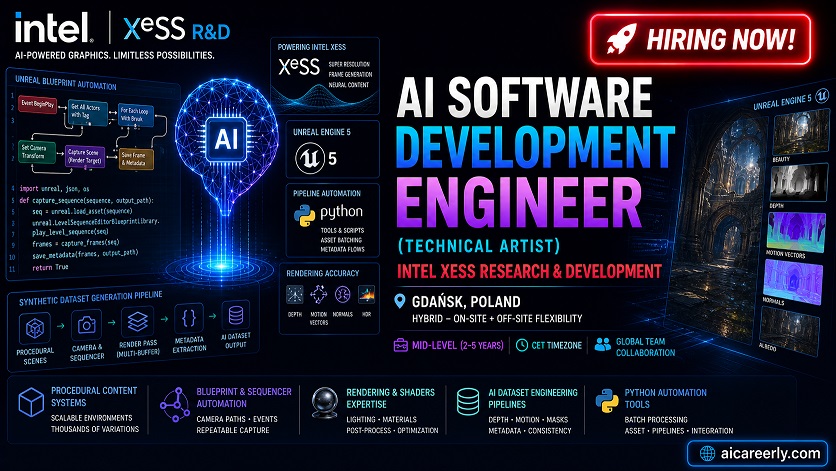
This role sits within Intel XeSS Research and Development, focusing on building next-generation AI-powered rendering systems such as super resolution, frame generation, and neural content workflows. The position is designed for a Mid-Level Technical Artist / Visual FX Engineer who can bridge real-time graphics production and AI-driven dataset generation. The ideal candidate will have strong expertise in Unreal Engine 4/5, procedural content pipelines, and automation workflows, contributing directly to scalable synthetic dataset creation used in advanced rendering research and product innovation.
🌍 Work Eligibility & Location
- 🌍 Visa Sponsorship: Not explicitly stated (Intel typically supports global hiring cases)
- ✈️ Relocation Support: Likely available for international hires
- 🏠 Remote Type: Hybrid (on-site in Gdansk + off-site flexibility)
- ⏰ Timezone Requirement: CET (Central European Time alignment preferred)
- 🌐 Country Restrictions: None specified
- 🗣️ Language Requirement: English (workforce collaboration language)
This position is based in Gdansk, Poland, with a flexible Hybrid work model combining onsite collaboration and remote execution. Intel’s global engineering structure suggests strong international accessibility, especially for candidates with AI graphics or Unreal Engine expertise. However, visa sponsorship and relocation support should be confirmed during the recruitment stage.
💰 Salary Intelligence
- 💰 Official Salary: Not disclosed
- 📊 Estimated Range: €60,000 – €110,000 annually (based on EU AI/graphics roles)
- 📈 Level: Mid-Level (2–5 years)
Intel does not publish compensation details for this role, but comparable AI rendering and Unreal Engine engineering positions in Europe typically fall within a competitive mid-to-senior compensation band. The package is likely enhanced by Intel benefits such as stock programs, bonuses, and pension plans, making the total compensation significantly stronger than base salary alone.
📊 Role Breakdown
This position focuses on building scalable systems for AI-driven rendering datasets inside the Intel XeSS ecosystem. You will work directly with engineers and researchers to create procedural environments and controlled simulation scenes using Unreal Engine 4/5. A core responsibility involves designing repeatable capture pipelines that generate high-quality synthetic data for training neural rendering models.
You will use Blueprint scripting and Sequencer to automate camera paths, scene events, and dataset capture sequences. A strong emphasis is placed on building procedural systems that can scale across thousands of variations of environments and effects. You will also develop automation tools using Python to streamline batch processing, asset generation, and metadata extraction workflows.
The role requires deep understanding of rendering pipelines, including lighting accuracy, shader behavior, and post-processing consistency. You will collaborate with AI engineers to ensure datasets include correct motion vectors, depth buffers, and deterministic outputs. Approximately 40–50% of your work involves content creation and procedural design, while the remaining 50–60% focuses on automation, tooling, and dataset engineering integration.
🧩 Required Skills & Fit
- ✅ Must: Unreal Engine 4/5 (lighting, materials, shaders)
- ✅ Must: Blueprint scripting and Sequencer workflows
- ✅ Must: 3D DCC tools like Maya, Blender, or 3ds Max
- ➕ Bonus: Python automation for pipelines
- ➕ Bonus: AI dataset generation experience
📈 Difficulty & Competitiveness
- ⚡ Level: High Mid-Level / Early Senior
- 📊 Experience barrier: 3+ years
- 🧠 Skill complexity: Advanced (AI + graphics + automation)
- 🌍 Competition: High (Intel AI/XeSS is a specialized domain)
This role is technically demanding due to its hybrid nature across real-time graphics, AI datasets, and procedural content engineering. Candidates with strong Unreal Engine pipelines plus scripting and automation experience will have a clear advantage. Competition is expected to be high given Intel’s reputation and the niche intersection of AI rendering and technical art.
🚀 Career Impact
- ⭐ Impact Rating: ⭐⭐⭐⭐⭐
- 🏢 Brand value: Intel AI & graphics leadership exposure
- 📚 Skill growth: Advanced AI rendering + dataset engineering
- 🚀 Future opportunities: AI research, game engine architecture, neural rendering
This role provides exceptional long-term career leverage in AI graphics engineering and neural rendering systems. Engineers gain exposure to cutting-edge XeSS technologies and large-scale dataset engineering pipelines, positioning them for future roles in AI research labs, game engine companies, or advanced simulation platforms.
📋 Key Responsibilities
You will be responsible for building and maintaining procedural scene generation systems inside Unreal Engine, ensuring environments are scalable and consistent for AI training workflows. This includes designing Blueprint-based automation for camera movement, scene events, and rendering sequences.
A major part of the role involves creating synthetic datasets with accurate lighting, depth, motion vectors, and post-processing outputs. You will collaborate with engineers to validate rendering correctness and ensure dataset reliability for AI model training.
Additionally, you will develop Python-based tools for batch processing assets and integrating metadata pipelines. Debugging shader behavior and optimizing rendering performance for data capture systems will also be key responsibilities. The role demands strong cross-functional collaboration between art, engineering, and AI research teams.
🎯 Application Strategy
- 🎯 Best apply method: Direct Intel careers portal
- 🔥 Highlight: Unreal Engine 5 pipeline expertise
- 🔥 Highlight: Python automation + procedural systems
- ❌ Avoid: Generic game art portfolios without technical depth
- ❌ Avoid: Weak shader or rendering understanding
🧠 Application Optimization (Adaptive)
This section is personalized by seniority.
How to use: Paste into ChatGPT, Claude, or Gemini
You are a senior technical recruiter.
Role:
AI Software Development Engineer (Technical Artist, XeSS R&D) at Intel focusing on Unreal Engine, AI dataset generation, procedural content systems, and rendering pipelines.
Candidate:
[Paste CV]
Optimize for this role.
Focus:
Signal strength
Role alignment
Missing high-impact elements
🧠 Fit & Positioning Analysis
Evaluate your match before applying.
Act as a hiring panel.
Evaluate:
Match score
Strengths
Gaps
Positioning improvements
📅 Application Signals
This role shows strong urgency due to its involvement in Intel XeSS R&D initiatives. Competition is expected to be high because of the rare intersection of AI rendering, Unreal Engine expertise, and dataset engineering. Candidates with procedural generation experience and Python automation will significantly improve selection probability.
🚀 Resume Optimization for This Role
⚡ Takes less than 2 minutes — optimize specifically for this position before applying
🎯 0/5 completed
Tailoring your CV to this exact role significantly increases your chances.
✅ Ready to apply — your profile is aligned with this role
🔗 Apply for this Job
✅ Job Source & Verification
This job listing is sourced from Intel’s official careers portal, ensuring high source credibility. The details reflect the most recent posting with last updated: 2026. Intel is a globally recognized semiconductor and AI infrastructure leader, making this listing highly reliable and relevant for AI graphics professionals seeking advanced career pathways.
Similar Jobs

JustHealth PhD Researcher (AI in Healthcare Ethics & Cardiology) – Leuven, Belgium | Visa + Salary Insights
Location: eu
Type: Full-time

Scientific Collaborator in AI-Enabled Precision Health – Lugano, Switzerland | Visa + Salary Insights
Location: eu
Type: Full-time

Assistant/Associate Professor in Embedded & Distributed AI – Palaiseau, France | Academic Salary Insights
Location: eu
Type: Contract
PhD Position in AI-Supported Transport Infrastructure Resilience – Zurich | Visa + Salary Insights
Location: eu
Type: Full-time

Postdoctoral Researcher in Machine Learning for Electric Vehicle Fleet Coordination – Gothenburg, Sweden | Visa + Salary Insights
Location: eu
Type: Full-time

Tech Lead LLM & Generative AI – Norway (Remote) | Visa + Salary Insights
Location: eu
Type: Full-time