
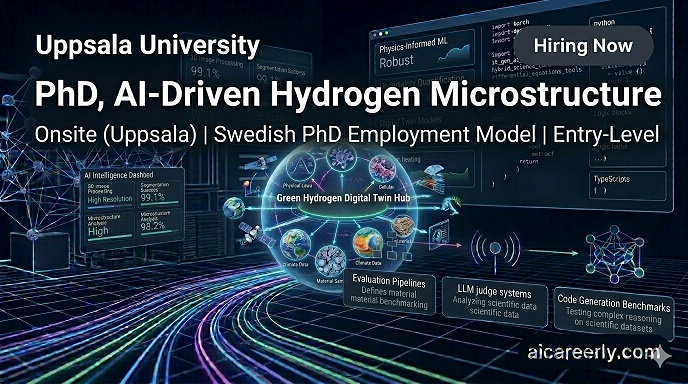
PhD Student in Computerized Image Processing & Physics-Informed Machine Learning for Green Hydrogen – Uppsala | Visa + Salary Insights
📍 Location: eu
🏷 Type: Not specified
Job Intelligence
📍 More in this location:
Browse AI jobs in eu
🏷 Similar roles:
🌐 Explore all jobs:
View all AI job listings
Job Overview
This PhD position at Uppsala University focuses on advancing computerized image processing and physics-informed machine learning for next-generation green hydrogen production technologies. The role is ideal for candidates with a strong foundation in AI, computer vision, or applied machine learning who are motivated to work at the intersection of 3D microstructure analysis and sustainable energy systems. The research directly contributes to improving proton exchange membrane water electrolyzers by developing digital twin models and optimization frameworks. It is best suited for an early-career researcher with strong analytical thinking, programming expertise, and interest in scientific machine learning.
🌍 Work Eligibility & Location
- 🌍 Visa Sponsorship: Not explicitly stated, but international PhD candidates are typically eligible for Swedish residence permits
- ✈️ Relocation Support: Likely available through university onboarding support
- 🏠 Remote Type: Onsite (Uppsala University, Sweden)
- ⏰ Timezone Requirement: CET (Central European Time)
- 🌐 Country Restrictions: None specified
- 🗣️ Language Requirement: English (full proficiency required)
This is a fully Onsite research PhD role based in Sweden. International applicants are strongly encouraged, and Sweden’s doctoral employment model typically supports residence permits for accepted candidates. While formal visa sponsorship is not explicitly mentioned, PhD positions in Swedish universities are commonly accessible to global researchers under structured immigration pathways.
💰 Salary Intelligence
- 💰 Official Salary: Fixed doctoral salary (Swedish PhD employment model)
- 📊 Estimated Range: Competitive Swedish PhD stipend-level salary (monthly paid)
- 📈 Level: Entry-Level Research (PhD Candidate)
The compensation follows Sweden’s structured doctoral employment system, meaning candidates receive a stable monthly salary rather than a stipend. This places the role in a competitive European research salary bracket with strong benefits, especially considering cost-of-living adjustments and academic security.
📊 Role Breakdown
This PhD focuses on building a full-stack scientific AI pipeline combining 3D image processing, machine learning, and physics-based modeling. A major component is developing automated segmentation systems for X-ray computed tomography data using deep learning. The extracted microstructural features are then used to construct probabilistic surrogate models that function as digital twins for predicting electrochemical performance in hydrogen production systems. Around 40% of the work is focused on imaging and feature extraction, while approximately 35% is dedicated to probabilistic modeling and uncertainty quantification. The remaining 25% involves Bayesian experimental design and optimization of manufacturing parameters. The role requires integrating Python-based machine learning pipelines, scientific computing, and physics-informed neural networks to bridge experimental data with predictive simulations.
🧩 Required Skills & Fit
- ✅ Must: Strong background in machine learning or computer vision
- ✅ Must: Proficiency in Python programming
- ✅ Must: Master’s degree in AI, physics, computer science, or related field
- ➕ Bonus: Experience with 3D image processing or XCT data
- ➕ Bonus: Knowledge of physics-informed machine learning
📈 Difficulty & Competitiveness
- ⚡ Level: High
- 📊 Experience barrier: 0–2 years (Master’s-level entry to PhD research)
- 🧠 Skill complexity: Advanced (AI + physics + imaging integration)
- 🌍 Competition: Very high (international research applicants)
This is a technically demanding PhD with strong competition due to its combination of AI, materials science, and energy systems. Candidates are expected to demonstrate strong mathematical maturity, research capability, and practical coding ability in scientific machine learning workflows.
🚀 Career Impact
- ⭐ Impact Rating: ⭐⭐⭐⭐⭐
- 🏢 Brand value: Top-tier European research university
- 📚 Skill growth: Advanced AI + scientific computing expertise
- 🚀 Future opportunities: AI research scientist, energy systems ML, academic careers
This role offers strong long-term value for careers in deep tech research, especially in AI-driven energy systems. Graduates typically transition into high-impact roles in academia, industrial research labs, or advanced AI engineering positions focused on sustainability and materials science.
📋 Key Responsibilities
The PhD candidate will develop end-to-end computational frameworks for analyzing and predicting material behavior in hydrogen production systems. Core responsibilities include building deep learning pipelines for segmentation of 3D XCT images, extracting meaningful microstructural descriptors, and integrating them into probabilistic surrogate models. The role also involves designing physics-informed machine learning models that bridge experimental observations with simulations. Additionally, the candidate will implement Bayesian optimization techniques to guide experimental design and improve manufacturing processes. A key responsibility is ensuring that all models incorporate uncertainty quantification to make predictions robust and physically interpretable.
🎯 Application Strategy
- 🎯 Best apply method: Direct university recruitment system submission
- 🔥 Highlight: Machine learning + computer vision experience
- 🔥 Highlight: Physics-informed modeling or scientific computing
- ❌ Avoid: Generic CV without research depth
- ❌ Avoid: Weak Python or math presentation
🧠 Application Optimization (Adaptive)
This section is personalized by seniority.
How to use: Paste into ChatGPT, Claude, or Gemini
You are a senior technical recruiter.
Role:
PhD in AI-driven image processing and physics-informed machine learning for hydrogen systems.
Candidate:
[Paste CV]
Optimize for this role.
Focus:
Signal strength
Role alignment
Missing high-impact elements
🧠 Fit & Positioning Analysis
Evaluate your match before applying.
Match score
Strengths
Gaps
Positioning improvements
📅 Application Signals
This is a highly competitive academic opportunity with strong international interest. Early application is critical due to limited PhD slots and collaboration with major industrial partners like Alleima and Sandvik. Candidates with strong AI and computational imaging backgrounds will stand out significantly. The selection process is rigorous, focusing on research potential, technical depth, and problem-solving ability. Delayed submission may reduce chances due to rolling evaluation pressure.
🚀 Resume Optimization for This Role
⚡ Takes less than 2 minutes — optimize specifically for this position before applying
🎯 0/5 completed
Tailoring your CV to this exact role significantly increases your chances.
✅ Ready to apply — your profile is aligned with this role
🔗 Apply for this Job
✅ Job Source & Verification
This job is sourced directly from Uppsala University’s official recruitment system, ensuring high institutional credibility and academic authenticity. The posting reflects a verified PhD research vacancy updated recently with defined deadlines and formal university governance. Last verified update: April 2026.
Similar Jobs

JustHealth PhD Researcher (AI in Healthcare Ethics & Cardiology) – Leuven, Belgium | Visa + Salary Insights
Location: eu
Type: Full-time

Scientific Collaborator in AI-Enabled Precision Health – Lugano, Switzerland | Visa + Salary Insights
Location: eu
Type: Full-time

Assistant/Associate Professor in Embedded & Distributed AI – Palaiseau, France | Academic Salary Insights
Location: eu
Type: Contract
PhD Position in AI-Supported Transport Infrastructure Resilience – Zurich | Visa + Salary Insights
Location: eu
Type: Full-time
Postdoctoral Researcher in Machine Learning for Electric Vehicle Fleet Coordination – Gothenburg, Sweden | Visa + Salary Insights
Location: eu
Type: Full-time

Tech Lead LLM & Generative AI – Norway (Remote) | Visa + Salary Insights
Location: eu
Type: Full-time