
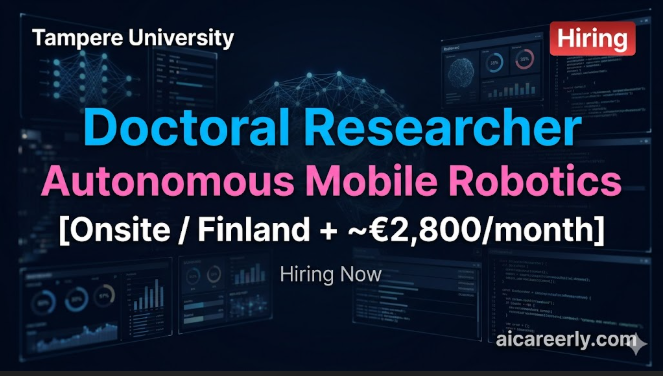
Doctoral Researchers (5-7 positions) in Autonomous Ground Robotics – Tampere, Finland | Visa + Salary Insights
📍 Location: eu
🏷 Type: Full-time
Job Intelligence
📍 More in this location:
Browse AI jobs in eu
🏷 Similar roles:
View similar Full-time jobs
🌐 Explore all jobs:
View all AI job listings
Job Overview
This doctoral researcher position focuses on advanced research in autonomous mobile robotics for extreme environments at Tampere University, Finland. The role sits within a large interdisciplinary initiative combining robotics, machine learning, computer vision, signal processing, and control systems. Selected candidates will contribute to developing small autonomous ground vehicles capable of operating in harsh Nordic conditions such as forests, snow, and uneven terrain. Ideal applicants are research-oriented engineers or scientists with strong analytical foundations and a passion for real-world robotics experimentation, simulation, and AI-driven autonomy.
📅 Job Timeline & Status
- 🏢 Company: Tampere University
- 🟢 Job Posted: 2026-05-28
- ⏳ Application Deadline: 2026-06-24 23:59 (UTC+3)
- 🔄 Last Verified: 2026-05-31
- 📌 Hiring Status: Actively Hiring
- 🔥 Expected Response Time: 3–6 weeks after deadline
This role is in an active recruitment phase with a clearly defined deadline. Because multiple PhD positions (4–7 slots) are available, the process is likely to be competitive but not ultra-restrictive in early screening. Candidates should treat this as a high-priority academic opening with strong international visibility. Application timing is important due to structured university hiring cycles, and early submission is recommended.
🌍 Work Eligibility & Location
- 🌍 Visa Sponsorship: Likely available for international PhD candidates
- ✈️ Relocation Support: Partial support and onboarding assistance expected
- 🏠 Remote Type: Onsite (lab + field robotics testing required)
- ⏰ Timezone Requirement: EET / EEST (Finland local coordination)
- 🌐 Country Restrictions: None explicitly stated
- 🗣️ Language Requirement: English (working language)
This is a fully research-intensive Onsite robotics PhD program based in Finland. International applicants are encouraged, and universities in Finland typically support doctoral visas and residence permits for researchers. Physical presence is essential due to hardware experimentation, robotics prototyping, and environmental testing in real-world terrains.
💰 Salary Intelligence
- 💰 Official Salary: ~€2,800/month starting
- 📊 Estimated Range: €2,800 – €3,600/month (based on progression)
- 📈 Level: Entry-Level Doctoral Researcher
This compensation reflects Finnish doctoral funding standards. While not comparable to industry AI salaries, it is competitive for academia with additional benefits such as research funding, travel grants, and institutional support. Salary increases progressively with research milestones and PhD advancement.
📊 Role Breakdown
This role is embedded in a large-scale robotics initiative focused on enabling autonomous ground vehicles to operate in extreme Nordic environments. Research spans multiple technical domains including robot perception, adaptive locomotion, AI-driven navigation, and multimodal sensing. Candidates will engage in both theoretical modeling and hands-on experimentation using real robotic platforms and simulated environments. Approximately 40–50% of the work involves algorithm development, while the remaining effort is dedicated to system integration, testing, and field validation. A strong emphasis is placed on robustness under uncertainty, especially in snowy forests and uneven terrain conditions. You will collaborate with international researchers and industry partners to build scalable autonomy systems.
🧩 Required Skills & Fit
- ✅ Must: MSc degree in Robotics, AI, Engineering, or related field
- ✅ Must: Strong programming in Python/C++
- ✅ Must: Background in machine learning, control, or robotics
- ➕ Bonus: Experience with computer vision or sensor fusion
- ➕ Bonus: Experience with ROS or autonomous systems
📈 Difficulty & Competitiveness
- ⚡ Level: High
- 📊 Experience barrier: 0–2 years (research-focused MSc expected)
- 🧠 Skill complexity: Advanced interdisciplinary robotics
- 🌍 Competition: High international applicant pool
Although classified as entry-level in academic terms, the technical bar is high due to the complexity of autonomous systems research. Applicants are expected to demonstrate strong mathematical reasoning, experimental mindset, and prior exposure to robotics or AI research workflows.
🚀 Career Impact
- ⭐ Impact Rating: ⭐⭐⭐⭐⭐
- 🏢 Brand value: Leading Finnish research university
- 📚 Skill growth: Advanced robotics + AI systems engineering
- 🚀 Future opportunities: Academia, robotics startups, AI R&D labs
This position provides strong long-term leverage for careers in robotics research, autonomous systems engineering, and AI innovation roles. Graduates often transition into postdoctoral positions or high-impact industrial R&D teams.
📋 Key Responsibilities
Candidates will design and implement algorithms for robot perception, navigation, and terrain adaptation. Responsibilities include developing machine learning models for environmental understanding, building robust control systems for uneven terrain locomotion, and integrating multimodal sensor inputs such as vision and audio. You will also contribute to simulation pipelines and real-world field testing in harsh outdoor environments. Collaboration with cross-disciplinary teams is essential, including mechanical engineering and signal processing experts. Documentation of experiments, publication of research papers, and participation in international conferences are core expectations of this doctoral role.
🎯 Application Strategy
- 🎯 Best apply method: University recruitment portal with tailored research proposal
- 🔥 Highlight: Robotics + AI integration experience
- 🔥 Highlight: Real-world experimentation skills
- ❌ Avoid: Generic academic CV without technical depth
- ❌ Avoid: Weak research alignment with robotics focus
🧠 Application Optimization (Adaptive)
This section is personalized by seniority.
Doctoral Researcher in Autonomous Ground Robotics focusing on perception, AI navigation, and terrain-adaptive control systems.Candidate:
[Paste CV]
Optimize for this role.
Focus:
* Signal strength
* Role alignment
* Missing high-impact elements
🧠 Fit & Positioning Analysis
Evaluate your match before applying. This role favors candidates with strong foundations in robotics systems, machine learning, and experimental research. Ideal applicants demonstrate prior project work in autonomous navigation or sensor-based AI systems. Strong publication potential or thesis-level research experience significantly improves competitiveness. Candidates lacking robotics exposure may face gaps in alignment but can compensate with strong ML or control theory backgrounds.
Act as a hiring panel.Evaluate:
* Match score
* Strengths
* Gaps
* Positioning improvements
📅 Application Signals
This role is in an active recruitment phase with a fixed deadline of June 24, 2026. Due to multiple available positions, applicant flow is expected to be high but structured. Early submissions improve visibility before peak volume. Expect moderate-to-high competition from European and global robotics candidates. Shortlisting and interviews typically begin shortly after the deadline, indicating a standard academic hiring cycle. Applicants should not delay as application urgency is high and selection is competitive.
🚀 Resume Optimization for This Role
⚡ Takes less than 2 minutes — optimize specifically for this position before applying
🎯 0/5 completed
Tailoring your CV to this exact role significantly increases your chances.
✅ Ready to apply — your profile is aligned with this role
🔗 Apply for this Job
✅ Job Source & Verification
This listing is sourced directly from Tampere University’s official recruitment announcement, making it a highly credible academic opportunity. Information reflects the latest available posting dated 2026-05-28, with verification updated on 2026-05-31. As an institutional PhD call, details are expected to remain stable until the official deadline unless updated by the university.
Similar Jobs


Lead Software Developer (AI Solutions) – Oxford, UK | Visa + Salary Insights
Location: gb
Type: Full-time

JustHealth PhD Researcher (AI in Healthcare Ethics & Cardiology) – Leuven, Belgium | Visa + Salary Insights
Location: eu
Type: Full-time

Scientific Collaborator in AI-Enabled Precision Health – Lugano, Switzerland | Visa + Salary Insights
Location: eu
Type: Full-time

Assistant/Associate Professor in Embedded & Distributed AI – Palaiseau, France | Academic Salary Insights
Location: eu
Type: Contract

PhD Position in AI-Supported Transport Infrastructure Resilience – Zurich | Visa + Salary Insights
Location: eu
Type: Full-time