
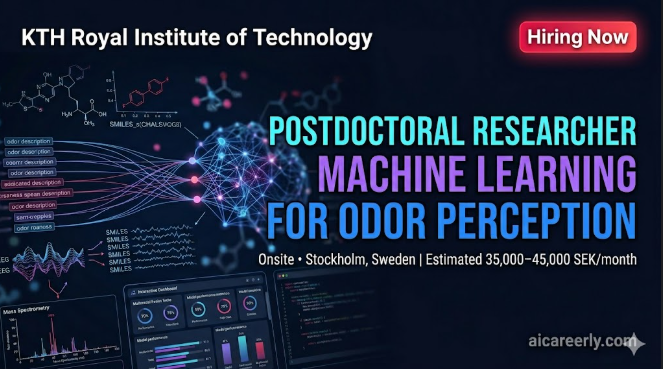
Postdocs in Machine Learning for Odor Perception – Stockholm | Visa + Salary Insights
📍 Location: eu
🏷 Type: Full-time
Job Intelligence
📍 More in this location:
Browse AI jobs in eu
🏷 Similar roles:
View similar Full-time jobs
🌐 Explore all jobs:
View all AI job listings
Job Overview
This postdoctoral position at KTH Royal Institute of Technology focuses on advancing machine learning methods for odor perception within the EU-funded “Digitising Smell” project. The role sits at the intersection of AI, neuroscience, and computational chemistry, aiming to model how humans perceive smell and translate it into digital representations. The ideal candidate is a highly skilled researcher with strong expertise in multimodal learning, capable of working with complex datasets such as EEG, chemical structures, and textual descriptions. This is a research-intensive role suited for candidates with a PhD and strong publication record in deep learning or computational modeling.
📅 Job Timeline & Status
- 🏢 Company: KTH Royal Institute of Technology
- 🟢 Job Posted: 28 May 2026
- ⏳ Application Deadline: 27 June 2026
- 🔄 Last Verified: 31 May 2026
- 📌 Hiring Status: Actively Hiring
- 🔥 Expected Response Time: 2–4 weeks after deadline
This role is in an active recruitment phase with a clearly defined deadline. Given the prestige of KTH and the EU research funding context, applications are expected to be competitive. Candidates should apply early, as screening may begin before 27 June 2026. The position is likely in the mid-cycle hiring stage, meaning shortlisting is ongoing but not yet finalized. Strong applicants in multimodal AI and computational neuroscience should treat this as high urgency.
🌍 Work Eligibility & Location
- 🌍 Visa Sponsorship: Likely supported (EU research institution)
- ✈️ Relocation Support: Expected for international postdocs
- 🏠 Remote Type: Primarily Onsite (Stockholm campus)
- ⏰ Timezone Requirement: CET/CEST alignment preferred
- 🌐 Country Restrictions: None specified
- 🗣️ Language Requirement: English
This is a globally accessible academic role, especially for PhD holders in AI and computational sciences. While based in Sweden, international applicants are highly likely eligible, with strong institutional support for relocation and visa processing. The work environment is primarily Onsite, reflecting lab-based collaboration across neuroscience, chemistry, and machine learning teams.
💰 Salary Intelligence
- 💰 Official Salary: Monthly salary (not disclosed)
- 📊 Estimated Range: 35,000–45,000 SEK/month
- 📈 Level: Postdoctoral Researcher (Mid-Level Academic Research)
While the exact compensation is not listed, postdoctoral salaries in Swedish technical universities typically fall within the 35K–45K SEK/month range. The compensation is competitive for European academic research roles and often includes benefits such as pension contributions and paid leave. Given the interdisciplinary nature of the project, the role is positioned at a strong mid-level research compensation tier for early-career PhD graduates.
📊 Role Breakdown
This role focuses on building next-generation AI systems that model olfactory perception using heterogeneous data sources. A major part of the work involves designing transformer-based architectures and graph neural networks (GNNs) to unify multimodal inputs such as EEG signals, chemical structures (SMILES strings), mass spectrometry outputs, images, and textual annotations. Approximately 40% of the work involves multimodal representation learning, while 30% focuses on time-series modeling of neural and sensor data. The remaining 30% involves chemical data representation and cross-modal alignment techniques. Candidates will also work with diffusion models and probabilistic frameworks for generative odor modeling. Strong Python engineering skills and proficiency in PyTorch, TensorFlow, or JAX are essential. This is a highly experimental research role requiring both theoretical depth and practical implementation across neuroscience and computational chemistry domains.
🧩 Required Skills & Fit
- ✅ Must: PhD in Machine Learning, AI, or related field
- ✅ Must: Experience with multimodal deep learning
- ✅ Must: Strong Python + ML frameworks (PyTorch/TensorFlow/JAX)
- ➕ Bonus: EEG or time-series signal processing experience
- ➕ Bonus: Computational chemistry or SMILES/graph modeling
📈 Difficulty & Competitiveness
- ⚡ Level: High
- 📊 Experience barrier: 5+ years equivalent research depth (PhD included)
- 🧠 Skill complexity: Very High (multimodal AI + neuroscience + chemistry)
- 🌍 Competition: Global academic applicant pool
This is a highly competitive research position requiring advanced expertise across multiple scientific domains. The High difficulty level reflects the need to integrate machine learning with neuroscience and chemical signal processing. Applicants are expected to have strong publication records and hands-on experience with complex multimodal systems.
🚀 Career Impact
- ⭐ Impact Rating: ⭐⭐⭐⭐⭐
- 🏢 Brand value: Elite European technical university
- 📚 Skill growth: Advanced multimodal AI + neuroscience integration
- 🚀 Future opportunities: AI research labs, biotech AI, sensory computing startups
This role offers exceptional career acceleration for researchers aiming to transition into frontier AI domains such as computational neuroscience, generative perception systems, and AI-driven sensory modeling. Experience gained here is highly transferable to top-tier research institutions and industrial AI labs.
📋 Key Responsibilities
The researcher will design and implement deep learning architectures for multimodal integration, focusing on olfactory data representation. Responsibilities include building transformer-based fusion models, developing graph neural networks for molecular data, and analyzing EEG and sensor-based time-series signals. The role also involves preprocessing heterogeneous datasets, including images, chemical descriptors, and textual annotations. A significant portion of work will focus on aligning biological signals with computational representations using probabilistic modeling and diffusion-based generative methods. Collaboration with interdisciplinary teams in neuroscience and chemistry is essential, along with publishing findings in high-impact journals and conferences.
🎯 Application Strategy
- 🎯 Best apply method: Direct KTH recruitment portal submission
- 🔥 Highlight: Multimodal deep learning research
- 🔥 Highlight: EEG or chemical ML experience
- ❌ Avoid: Generic ML-only CV without domain depth
- ❌ Avoid: Weak publication or research framing
🧠 Application Optimization (Adaptive)
This section is personalized by seniority.
How to use: Paste into ChatGPT, Claude, or Gemini
Postdoc in Machine Learning for Odor Perception involving multimodal AI (EEG, chemical graphs, images, text) at KTH Royal Institute of Technology.Candidate:
[Paste CV]Optimize for this role.Focus:Signal strength
Role alignment
Missing high-impact elements
🧠 Fit & Positioning Analysis
Evaluate your match before applying.
Act as a hiring panel.Evaluate:
Match score
Strengths
Gaps
Positioning improvements
📅 Application Signals
This role shows strong application urgency due to a fixed deadline of 27 June 2026. Competition is expected to be high, given the interdisciplinary AI + neuroscience focus and EU funding backing. Candidates should anticipate a structured review process beginning shortly after submission, with interview cycles likely within 2–6 weeks post-deadline. Because KTH attracts global academic talent, early application submission is strongly recommended. Roles of this type may close without extensive extensions if strong candidates are identified early.
🚀 Resume Optimization for This Role
⚡ Takes less than 2 minutes — optimize specifically for this position before applying
🎯 0/5 completed
Tailoring your CV to this exact role significantly increases your chances.
✅ Ready to apply — your profile is aligned with this role
🔗 Apply for this Job
✅ Job Source & Verification
Source credibility: Official KTH Royal Institute of Technology recruitment system ensures high authenticity and academic legitimacy.
Last updated: 31 May 2026.
This listing is directly extracted from a verified university job portal, making it a high-trust academic opportunity with reliable deadlines and structured hiring procedures.
Similar Jobs


Lead Software Developer (AI Solutions) – Oxford, UK | Visa + Salary Insights
Location: gb
Type: Full-time

JustHealth PhD Researcher (AI in Healthcare Ethics & Cardiology) – Leuven, Belgium | Visa + Salary Insights
Location: eu
Type: Full-time

Scientific Collaborator in AI-Enabled Precision Health – Lugano, Switzerland | Visa + Salary Insights
Location: eu
Type: Full-time

Assistant/Associate Professor in Embedded & Distributed AI – Palaiseau, France | Academic Salary Insights
Location: eu
Type: Contract

PhD Position in AI-Supported Transport Infrastructure Resilience – Zurich | Visa + Salary Insights
Location: eu
Type: Full-time