
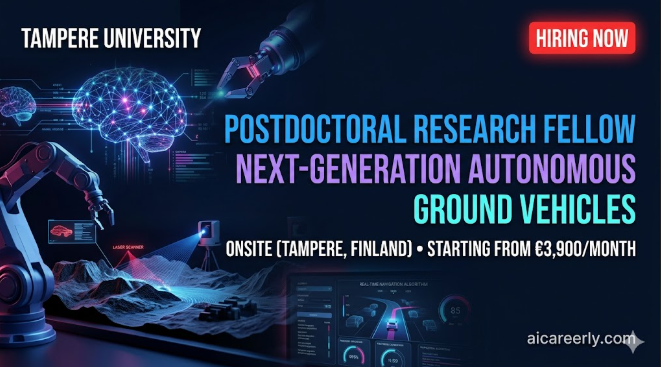
Research Contract in Informatics – Dialogue Systems & Language Learning (LLADIGA) | Bozen-Bolzano (Italy) | Visa Insights
📍 Location: eu
🏷 Type: Contract
Job Intelligence
📍 More in this location:
Browse AI jobs in eu
🏷 Similar roles:
View similar Contract jobs
🌐 Explore all jobs:
View all AI job listings
Job Overview
This research contract in Informatics at the Faculty of Engineering, Free University of Bozen-Bolzano, focuses on the project “Learning Language with Dialogue Games (LLADIGA)”. The role is designed for a research-oriented candidate with strong foundations in computational linguistics, dialogue systems, and AI-driven language modeling. The selected researcher will contribute to advancing interactive language learning systems using structured dialogue frameworks and machine learning approaches. Ideal candidates typically hold or are completing a PhD in Computer Science, Artificial Intelligence, or Computational Linguistics, with experience in experimental research and NLP methodologies.
📅 Job Timeline & Status
- 🏢 Company: Free University of Bozen-Bolzano
- 🟢 Job Posted: 28-05-2026
- ⏳ Application Deadline: 29-06-2026 12:00
- 🔄 Last Verified: 31-05-2026
- 📌 Hiring Status: Actively Hiring
- 🔥 Expected Response Time: 3–6 weeks after deadline
This position is currently in an active application phase with a clearly defined deadline. Since the closing date is approaching within a few weeks, the recruitment is likely in the early-to-mid evaluation stage. Applicants should prioritize early submission because competition is expected to increase significantly closer to 29-06-2026. The structured academic selection process indicates that shortlisted candidates will be evaluated shortly after the deadline, making timely application critical.
🌍 Work Eligibility & Location
- 🌍 Visa Sponsorship: Possible depending on eligibility and academic profile
- ✈️ Relocation Support: Not explicitly stated
- 🏠 Remote Type: Onsite / Hybrid research environment
- ⏰ Timezone Requirement: Central European Time (CET)
- 🌐 Country Restrictions: EU and Non-EU applicants eligible under Italian academic regulations
- 🗣️ Language Requirement: English (plus potential Italian/German advantage)
This role is primarily Onsite within an Italian academic institution, with possible hybrid flexibility depending on research needs. International candidates may apply, but administrative compliance under Italian academic law applies. Visa sponsorship is not explicitly guaranteed but research contracts in EU universities often support non-EU researchers through institutional processes.
💰 Salary Intelligence
- 💰 Official Salary: Not publicly specified
- 📊 Estimated Range: €28,000 – €45,000 per year (academic research contract estimate)
- 📈 Level: Mid-Level Researcher
While no official salary is disclosed, European research contracts in Informatics typically align with national academic funding bands. The estimated compensation reflects a Mid-Level research position with competitive EU research standards, particularly for AI and NLP-focused projects.
📊 Role Breakdown
The researcher will contribute to the LLADIGA (Learning Language with Dialogue Games) project, focusing on building computational models that simulate and analyze human dialogue for language learning. Approximately 40% of the role involves developing dialogue-based machine learning systems, while another 25% focuses on dataset construction and linguistic annotation. Around 20% of responsibilities include experimental evaluation of NLP models, including performance benchmarking and statistical analysis. The remaining 15% is dedicated to academic writing, publishing research findings, and collaborating with interdisciplinary teams in computational linguistics and cognitive science.
Key technical exposure includes Natural Language Processing (NLP), machine learning frameworks, and dialogue system architectures. Candidates may work with transformer-based models, reinforcement learning techniques for conversational agents, and structured linguistic datasets. Strong emphasis is placed on research reproducibility, experimental rigor, and publication-quality outputs. This is a highly analytical role requiring both theoretical understanding and applied implementation skills in AI-driven language technologies.
🧩 Required Skills & Fit
- ✅ Must: PhD or advanced research experience in Informatics or AI
- ✅ Must: Strong background in NLP and dialogue systems
- ✅ Must: Experience with Python and ML frameworks
- ➕ Bonus: Knowledge of cognitive modeling or language learning systems
- ➕ Bonus: Academic publication record in AI/NLP conferences
📈 Difficulty & Competitiveness
- ⚡ Level: Advanced Academic Research
- 📊 Experience barrier: 2–5+ years (research-heavy profile preferred)
- 🧠 Skill complexity: High (AI, NLP, experimental research)
- 🌍 Competition: High (international academic applicants)
This is a HIGH difficulty research role due to its specialized focus on AI-driven dialogue systems and academic research output expectations. Candidates are expected to demonstrate both theoretical depth and applied machine learning capability. Competition is typically strong in European Informatics research grants, especially for NLP-focused projects.
🚀 Career Impact
- ⭐ Impact Rating: ⭐⭐⭐⭐⭐
- 🏢 Brand value: European research university
- 📚 Skill growth: Advanced NLP + dialogue AI expertise
- 🚀 Future opportunities: PhD continuation, postdoc, AI research roles
This role offers strong career acceleration in academic AI research, particularly in conversational AI and computational linguistics. It can serve as a gateway to postdoctoral positions, industry AI research labs, or doctoral advancement in Europe and beyond.
📋 Key Responsibilities
The researcher will design and implement dialogue-based AI models for language learning systems under the LLADIGA project. Responsibilities include building machine learning pipelines, developing annotated linguistic datasets, and conducting experiments on conversational performance. The role also requires working with Python-based NLP frameworks, transformer models, and evaluation metrics for dialogue coherence and learning efficiency. Additional duties include preparing academic publications, participating in research discussions, and collaborating with interdisciplinary teams in linguistics and AI. Strong focus is placed on reproducibility, experimental design, and advancing theoretical models of language learning through structured dialogue games.
🎯 Application Strategy
- 🎯 Best apply method: University application portal (formal academic submission)
- 🔥 Highlight: NLP research experience
- 🔥 Highlight: Published papers or thesis work
- ❌ Avoid: Generic software engineering CVs
- ❌ Avoid: Non-research-focused resumes
🧠 Application Optimization (Adaptive)
This section is personalized by seniority.
How to use: Paste into ChatGPT, Claude, or Gemini
Research Contract in Informatics – Dialogue Games and NLP (LLADIGA project)Candidate:
[Paste CV]
Optimize for this role.
Focus:
Signal strength
Role alignment
Missing high-impact elements
🧠 Fit & Positioning Analysis
Evaluate your match before applying.
Match score
Strengths
Gaps
Positioning improvements
📅 Application Signals
The role shows strong application urgency due to a fixed deadline on 29-06-2026. Competition is expected to be high because of its AI and NLP research focus. Since academic review cycles typically begin immediately after closing, candidates should expect fast initial screening followed by structured evaluation phases. Early submission is strongly recommended as shortlisted candidate pools in EU research roles are often formed before deadline closure.
🚀 Resume Optimization for This Role
⚡ Takes less than 2 minutes — optimize specifically for this position before applying
🎯 0/5 completed
Tailoring your CV to this exact role significantly increases your chances.
✅ Ready to apply — your profile is aligned with this role
🔗 Apply for this Job
✅ Job Source & Verification
This listing is sourced from an official European university recruitment portal, ensuring high institutional credibility. The data reflects the most recent update as of 31-05-2026, confirming that the position is currently active and open for applications. All details align with academic recruitment standards under Italian law (Law 240/2010), making this a reliable and formally regulated research opportunity within the EU higher education system.
Similar Jobs

JustHealth PhD Researcher (AI in Healthcare Ethics & Cardiology) – Leuven, Belgium | Visa + Salary Insights
Location: eu
Type: Full-time

Scientific Collaborator in AI-Enabled Precision Health – Lugano, Switzerland | Visa + Salary Insights
Location: eu
Type: Full-time

Assistant/Associate Professor in Embedded & Distributed AI – Palaiseau, France | Academic Salary Insights
Location: eu
Type: Contract
PhD Position in AI-Supported Transport Infrastructure Resilience – Zurich | Visa + Salary Insights
Location: eu
Type: Full-time
Postdoctoral Researcher in Machine Learning for Electric Vehicle Fleet Coordination – Gothenburg, Sweden | Visa + Salary Insights
Location: eu
Type: Full-time

Developer II – Analytics & AI | Montréal (Hybrid Onsite) | Salary Insights + Enterprise Data Engineering
Location: ca
Type: Contract