
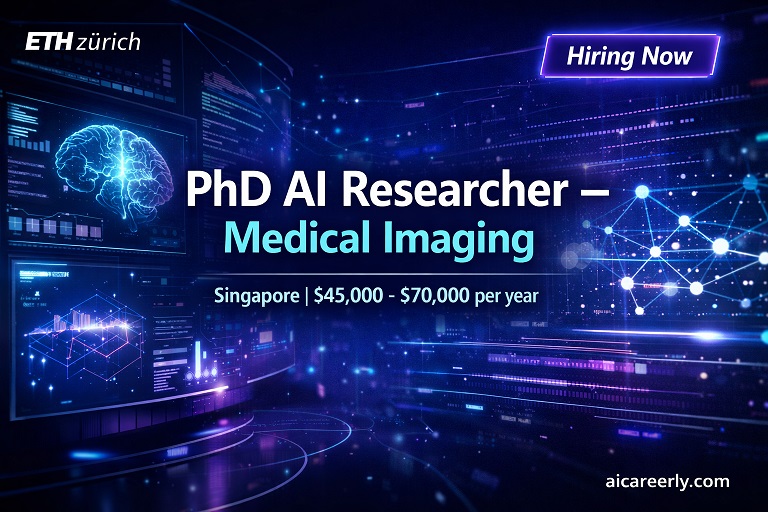
PhD AI Researcher (Medical Imaging) – ETH Zurich Singapore Role
📍 Location: eu
🏷 Type: Not specified
Job Intelligence
📍 More in this location:
Browse AI jobs in eu
🏷 Similar roles:
🌐 Explore all jobs:
View all AI job listings
Job Overview
This PhD-level AI research role focuses on advancing medical imaging AI for musculoskeletal (MSK) health at a globally recognized research hub. Ideal for candidates with a strong machine learning background (Mid-Level transitioning to Research Track), the position centers on building multimodal foundation models for healthcare applications. You will work on cross-modal data integration, predictive modeling, and clinically relevant AI systems, contributing to next-generation diagnostics in aging populations. This role suits technically rigorous candidates aiming to bridge AI research and real-world healthcare impact.
🌍 Work Eligibility & Location
- 🌍 Visa Sponsorship: Yes (Singapore research visa supported)
- ✈️ Relocation Support: Yes
- 🏠 Remote Type: Hybrid (up to 2 days/week remote)
- ⏰ Timezone Requirement: Singapore standard working hours
- 🌐 Country Restrictions: None specified
- 🗣️ Language Requirement: English (fluent)
This role is globally accessible, with visa sponsorship and relocation assistance enabling international candidates to work in Singapore. While not fully remote, the Hybrid setup provides flexibility. Candidates must align with Singapore working hours and collaborate in a multidisciplinary, international research environment.
💰 Salary Intelligence
- 💰 Official Salary: Not disclosed
- 📊 Estimated Range: $45,000 – $70,000/year (PhD stipend equivalent)
- 📈 Level: Mid-Level (Research Track / PhD)
While the official compensation is not listed, comparable PhD roles in Singapore suggest a competitive funded research package with full tuition coverage and stipend. The value lies in research exposure, institutional prestige, and long-term career acceleration, rather than short-term salary maximization.
📊 Role Breakdown
This role is heavily research-oriented, with approximately 40% focused on model development, including self-supervised learning, multimodal representation learning, and foundation model adaptation using frameworks like PyTorch and Python. Around 25% involves cross-modal AI innovation, where you will design latent space representations enabling translation between imaging modalities and clinical datasets. Another 20% is dedicated to evaluation, applying models to downstream clinical tasks such as fracture risk prediction and biomechanical biomarker extraction. The remaining 15% includes collaboration and mentorship, such as co-supervising students and working with interdisciplinary teams. Core actions include training large-scale models, optimizing pipelines, and deploying clinically relevant AI systems. This is a technically demanding role requiring deep expertise in machine learning systems and medical data workflows.
🧩 Required Skills & Fit
- ✅ Must: Strong foundation in machine learning and AI
- ✅ Must: Proficiency in Python and ML frameworks (e.g., PyTorch)
- ✅ Must: Experience in image processing or computer vision
- ➕ Bonus: Knowledge of multimodal learning or foundation models
- ➕ Bonus: Experience with high-performance computing (HPC)
📈 Difficulty & Competitiveness
- ⚡ Level: High
- 📊 Experience barrier: 2–5 years (plus MSc degree)
- 🧠 Skill complexity: Advanced research + engineering hybrid
- 🌍 Competition: Global academic and AI research talent pool
This is a high-difficulty role due to its combination of research depth and engineering execution. Candidates must demonstrate both theoretical knowledge and applied ML capability. With 2–5 years of relevant experience expected, competition includes top-tier graduates and early-career researchers globally.
🚀 Career Impact
- ⭐ Impact Rating: ⭐⭐⭐⭐☆
- 🏢 Brand value: ETH Zurich research affiliation
- 📚 Skill growth: Advanced AI + medical domain expertise
- 🚀 Future opportunities: AI research, healthcare AI, academia
This role offers strong career acceleration into AI research, especially in healthcare. The ETH Zurich affiliation significantly boosts academic credibility, while hands-on work in foundation models and multimodal AI positions candidates for high-impact roles in both industry and academia. Long-term outcomes include research scientist roles, PhD-level AI leadership, or specialized positions in medical AI innovation.
📋 Key Responsibilities
You will develop and pretrain large-scale AI models for medical imaging using self-supervised learning and multimodal architectures. Core responsibilities include designing cross-modal learning systems, implementing fusion and translation techniques, and applying models to clinical prediction tasks. You will evaluate model performance on real-world healthcare datasets, focusing on bone health analysis and fracture risk prediction. Additional duties involve collaborating with interdisciplinary teams, optimizing training pipelines, and mentoring MSc/BSc students. This role requires continuous experimentation with cutting-edge AI techniques and adapting them to clinically relevant use cases.
🎯 Application Strategy
- 🎯 Best apply method: Official ETH Zurich application portal
- 🔥 Highlight: Research projects in machine learning or computer vision
- 🔥 Highlight: Experience with multimodal or large-scale models
- ❌ Avoid: Generic CV without research depth
- ❌ Avoid: Lack of technical project evidence (GitHub/publications)
🧠 Application Optimization (Adaptive)
This section is personalized by seniority.
How to use: Paste into ChatGPT, Claude, or Gemini
You are a senior technical recruiter.
Role:
PhD AI researcher working on multimodal medical imaging models for MSK health, focusing on foundation models, cross-modal learning, and clinical AI deployment.
Candidate:
[Paste CV]
Optimize for this role.
Focus:
Signal strength
Role alignment
Missing high-impact elements
🧠 Fit & Positioning Analysis
Evaluate your match before applying.
Act as a hiring panel.
Evaluate:
Match score
Strengths
Gaps
Positioning improvements
📅 Application Signals
This role shows moderate urgency typical of funded PhD positions, but early application increases advantage due to rolling evaluation. Expect high competition from international candidates with strong academic backgrounds. Submitting a technically strong and tailored application is critical to stand out.
⚡ Takes less than 2 minutes — optimize specifically for this position before applying
🎯 0/5 completed
Tailoring your CV to this exact role significantly increases your chances.
✅ Ready to apply — your profile is aligned with this role
🔗 Apply for this Job
✅ Job Source & Verification
This job is sourced directly from the official ETH Zurich careers platform, ensuring high source credibility and accurate role representation. Details reflect the most recent listing available, with last updated in 2026. Applicants should verify deadlines and submission requirements through the official application portal.
Similar Jobs
JustHealth PhD Researcher (AI in Healthcare Ethics & Cardiology) – Leuven, Belgium | Visa + Salary Insights
Location: eu
Type: Full-time
Scientific Collaborator in AI-Enabled Precision Health – Lugano, Switzerland | Visa + Salary Insights
Location: eu
Type: Full-time
Assistant/Associate Professor in Embedded & Distributed AI – Palaiseau, France | Academic Salary Insights
Location: eu
Type: Contract
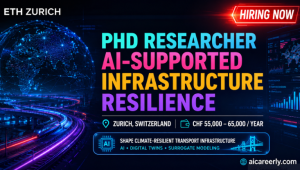
PhD Position in AI-Supported Transport Infrastructure Resilience – Zurich | Visa + Salary Insights
Location: eu
Type: Full-time
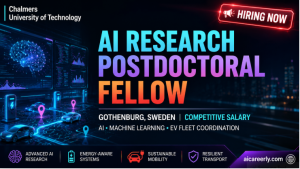
Postdoctoral Researcher in Machine Learning for Electric Vehicle Fleet Coordination – Gothenburg, Sweden | Visa + Salary Insights
Location: eu
Type: Full-time

Tech Lead LLM & Generative AI – Norway (Remote) | Visa + Salary Insights
Location: eu
Type: Full-time