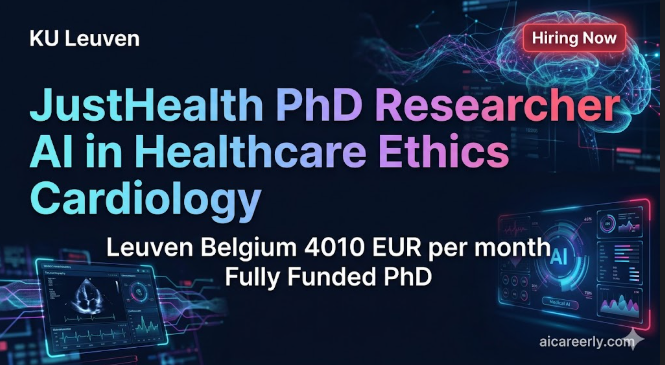
JustHealth PhD Researcher (AI in Healthcare Ethics & Cardiology) – Leuven, Belgium | Visa + Salary Insights
📍 Location: eu
🏷 Type: Full-time
Job Intelligence
📍 More in this location:
Browse AI jobs in eu
🏷 Similar roles:
View similar Full-time jobs
🌐 Explore all jobs:
View all AI job listings
Job Overview
This PhD position at KU Leuven focuses on developing a just, scalable AI-driven healthcare framework for rheumatic heart disease screening using foundation model (FM)-enhanced echocardiography and phonocardiography (PCG). The candidate will work at the intersection of cardiology, AI governance, and global health equity, embedded in a highly specialized cardiovascular imaging research environment. The ideal applicant combines clinical understanding with an interest in machine learning, implementation science, and ethical AI deployment in low-resource healthcare settings.
📅 Job Timeline & Status
- 🏢 Company: KU Leuven
- 🟢 Job Posted: 12/06/2026
- ⏳ Application Deadline: 10/07/2026
- 🔄 Last Verified: 17/06/2026
- 📌 Hiring Status: Actively Hiring
- 🔥 Expected Response Time: 4–10 weeks after deadline
This role is in a high-activity recruitment phase, with applications currently open and actively reviewed after submission. Given the MSCA doctoral funding structure and limited PhD slots, competition is expected to intensify closer to the deadline. Candidates should apply early, as shortlisting may begin before the official closing date. This is an urgent, high-competition doctoral opportunity in AI + cardiovascular medicine.
🌍 Work Eligibility & Location
- 🌍 Visa Sponsorship: Yes (MSCA mobility framework applies)
- ✈️ Relocation Support: Yes
- 🏠 Remote Type: Onsite (Leuven-based with international secondments)
- ⏰ Timezone Requirement: CET (Belgium)
- 🌐 Country Restrictions: MSCA mobility rule (no extended prior residence in Belgium)
- 🗣️ Language Requirement: English (C1 minimum)
This is a fully funded international doctoral role with strict EU mobility constraints. Candidates must not have spent more than 12 months in Belgium in the last 3 years. The role includes structured international secondments (South Africa and USA), making it highly accessible to global researchers despite being Onsite in Leuven.
💰 Salary Intelligence
- 💰 Official Salary: €4,010/month gross
- 📊 Estimated Range: €4,000–€5,300/month gross (with allowances)
- 📈 Level: Early Research / Doctoral Level
This PhD offers a strong European research compensation package. With mobility (€710/month) and potential family allowance (€660/month), total compensation becomes highly competitive for doctoral researchers. The funding is consistent with EU Marie Skłodowska-Curie standards, positioning it above many standard PhD stipends in Europe.
📊 Role Breakdown
This role is centered on building a foundation model-enabled clinical AI pipeline for rheumatic heart disease detection using handheld echocardiography and PCG data. Around 40% of the work focuses on clinical data acquisition and annotation, ensuring high-quality multimodal datasets. Another 30% involves training and fine-tuning AI foundation models to detect and stage disease severity. Approximately 20% focuses on designing equitable care pathways for deployment in low-resource settings, working closely with nurses and community health workers. The final 10% involves governance analysis, ensuring the AI system aligns with ethical and decolonized healthcare frameworks.
Technically, the candidate will engage with echocardiography imaging systems, phonocardiogram signal processing, and multimodal AI architectures. The research requires understanding of cardiac mechanics, clinical validation protocols, and AI robustness evaluation against gold-standard diagnostics. The project also emphasizes translation into real-world healthcare systems, requiring strong interdisciplinary collaboration between clinical teams, engineers, and public health stakeholders.
🧩 Required Skills & Fit
- ✅ Must: Master’s degree in Medicine, Biomedical Sciences, or related field
- ✅ Must: Clinical exposure to cardiology, echocardiography, or PCG
- ✅ Must: Research experience in health systems or AI in healthcare
- ➕ Bonus: Machine learning or foundation model exposure
- ➕ Bonus: Fieldwork in low-resource healthcare settings
📈 Difficulty & Competitiveness
- ⚡ Level: High
- 📊 Experience barrier: 0–2 years post-master (but strong clinical/research profile required)
- 🧠 Skill complexity: Advanced interdisciplinary (AI + cardiology + ethics)
- 🌍 Competition: Very High (global MSCA applicant pool)
This is a HIGH difficulty PhD due to its dual requirement of clinical competence and AI research capability. Candidates are evaluated not only on academic excellence but also on their ability to integrate real-world healthcare deployment, ethical AI design, and clinical validation workflows.
🚀 Career Impact
- ⭐ Impact Rating: ⭐⭐⭐⭐⭐
- 🏢 Brand value: KU Leuven + global cardiology research network
- 📚 Skill growth: AI in healthcare + cardiovascular imaging
- 🚀 Future opportunities: Academic PI, AI healthcare lead, global health AI roles
This PhD significantly accelerates access to top-tier academic research careers and high-impact roles in health AI governance, clinical AI systems, and global health innovation. The combination of KU Leuven’s research ecosystem and international secondments creates strong positioning for long-term leadership in AI-enabled healthcare transformation.
📋 Key Responsibilities
The selected researcher will be responsible for designing and validating a handheld echocardiography and PCG-based data collection system for rheumatic heart disease detection. This includes building annotated datasets, coordinating field data acquisition, and ensuring clinical reliability of foundation model (FM) outputs. The role requires developing and testing AI models against gold-standard cardiology diagnostics while maintaining strict attention to clinical validity.
Additional responsibilities include co-designing a scalable care pathway with healthcare workers in low-resource settings, conducting implementation research, and evaluating ethical implications of AI deployment. The researcher will also participate in international collaborations, contribute to clinical publications, and support validation studies across multiple healthcare environments.
🎯 Application Strategy
- 🎯 Best apply method: Strong CV + research-focused motivation letter
- 🔥 Highlight: Clinical cardiology exposure
- 🔥 Highlight: AI / data science experience in healthcare
- ❌ Avoid: Generic ML-only applications without clinical grounding
- ❌ Avoid: Weak motivation for global health impact
🧠 Application Optimization (Adaptive)
This section is personalized by seniority.
You are a senior technical recruiter.
Role:
PhD Researcher in AI-driven cardiovascular diagnostics, focusing on foundation models for echocardiography and phonocardiography in rheumatic heart disease screening.
Candidate:
[Paste CV]
Optimize for this role.
Focus:
Signal strength
Role alignment
Missing high-impact elements
🧠 Fit & Positioning Analysis
Evaluate your match before applying.
Act as a hiring panel.
Evaluate:
Match score
Strengths
Gaps
Positioning improvements
Similar Jobs


Lead Software Developer (AI Solutions) – Oxford, UK | Visa + Salary Insights
Location: gb
Type: Full-time

Scientific Collaborator in AI-Enabled Precision Health – Lugano, Switzerland | Visa + Salary Insights
Location: eu
Type: Full-time

Assistant/Associate Professor in Embedded & Distributed AI – Palaiseau, France | Academic Salary Insights
Location: eu
Type: Contract
PhD Position in AI-Supported Transport Infrastructure Resilience – Zurich | Visa + Salary Insights
Location: eu
Type: Full-time