
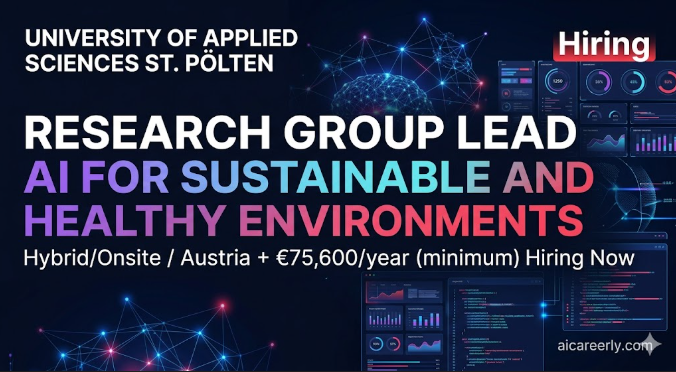
Research Group Lead AI for Sustainable and Healthy Environments – St. Pölten, Austria | Visa + Salary Insights
📍 Location: eu
🏷 Type: Full-time
Job Intelligence
📍 More in this location:
Browse AI jobs in eu
🏷 Similar roles:
View similar Full-time jobs
🌐 Explore all jobs:
View all AI job listings
Job Overview
This senior academic leadership role at the University of Applied Sciences St. Pölten focuses on building a new interdisciplinary research group centered on Artificial Intelligence, sustainable systems, and healthy environments. The ideal candidate will establish a research agenda, recruit PhD talent, and drive applied innovation in collaboration with European partners such as TU Wien and the E³UDRES² alliance. This position is designed for experienced researchers with a strong publication record, proven funding success, and the ability to translate AI research into real-world environmental and societal impact.
📅 Job Timeline & Status
- 🏢 Company: University of Applied Sciences St. Pölten
- 🟢 Job Posted: May 2026 (Estimated based on publication cycle)
- ⏳ Application Deadline: Deadline not publicly specified
- 🔄 Last Verified: 31 May 2026
- 📌 Hiring Status: Actively Hiring
- 🔥 Expected Response Time: 2–4 weeks
This role is in an early-to-mid recruitment phase, meaning candidate evaluation is likely ongoing but not yet closed. Given the seniority and competitive nature of research leadership positions in European applied sciences institutions, applicants should treat this as high urgency. Positions tied to PhD supervision capacity and external funding pipelines tend to fill quickly once strong profiles are identified.
🌍 Work Eligibility & Location
- 🌍 Visa Sponsorship: Likely available for highly qualified international researchers (case-dependent)
- ✈️ Relocation Support: Possible for senior academic hires
- 🏠 Remote Type: Hybrid / Onsite
- ⏰ Timezone Requirement: Central European Time (CET)
- 🌐 Country Restrictions: None explicitly stated
- 🗣️ Language Requirement: English (German advantageous but not mandatory)
The role is based in Austria and embedded in a European research ecosystem, making it highly accessible for EU and international academics. While remote flexibility exists for certain research activities, leadership responsibilities, PhD supervision, and institutional collaboration require significant on-site presence.
💰 Salary Intelligence
- 💰 Official Salary: €75,600 per year (minimum)
- 📊 Estimated Range: €75,600 – €95,000+ annually
- 📈 Level: Senior Academic / Research Group Lead
This compensation reflects a senior-level academic leadership position with additional value derived from research funding opportunities, PhD supervision roles, and international collaboration. Compared to European applied sciences institutions, the salary is competitive but heavily augmented by grant acquisition potential and long-term academic career stability.
📊 Role Breakdown
This position is structured as a strategic research leadership role where approximately 40% of time is dedicated to research agenda design, 25% to team leadership and PhD supervision, 20% to external funding acquisition, and 15% to teaching integration and institutional collaboration. The candidate will define and lead an AI-driven research group focused on sustainable and healthy environments, integrating domains such as machine learning, environmental informatics, and data-driven sustainability modeling. A key expectation is building demonstrators and living-lab applications that connect theoretical AI research with real-world environmental systems. Collaboration with TU Wien and European alliance partners is central, requiring strong cross-institutional coordination skills. The role also involves establishing long-term research pipelines, supervising up to five PhD candidates, and ensuring consistent publication output in high-impact venues.
🧩 Required Skills & Fit
- ✅ Must: PhD in AI, Data Science, Environmental Informatics, or related field
- ✅ Must: Strong international publication record
- ✅ Must: Experience in research leadership and team building
- ➕ Bonus: EU research funding acquisition experience (Horizon Europe)
- ➕ Bonus: Industry collaboration in AI sustainability systems
📈 Difficulty & Competitiveness
- ⚡ Level: Very High
- 📊 Experience barrier: 5+ years
- 🧠 Skill complexity: Advanced interdisciplinary AI + academic leadership
- 🌍 Competition: High international applicant pool
This is a highly selective senior academic position requiring not only technical expertise in AI but also demonstrated leadership in building research ecosystems. Candidates without funding track records or interdisciplinary experience will face significant barriers in selection.
🚀 Career Impact
- ⭐ Impact Rating: ⭐⭐⭐⭐⭐
- 🏢 Brand value: Strong European applied sciences institution
- 📚 Skill growth: Research leadership, AI-for-sustainability expertise
- 🚀 Future opportunities: Tenure-track equivalent, EU consortium leadership roles
This role offers exceptional long-term academic positioning, especially for researchers aiming to transition into European research leadership or multi-institutional AI sustainability programs. It significantly strengthens eligibility for large-scale EU funding consortia and senior professorship trajectories.
📋 Key Responsibilities
The selected candidate will be responsible for establishing and scaling a new AI research group from the ground up, including defining a long-term research strategy aligned with institutional priorities. Core duties include leading AI-driven sustainability research, supervising PhD candidates, and securing competitive third-party funding. The role also requires designing and deploying real-world AI demonstrators in environmental and health-related domains. Collaboration with institutions like TU Wien and E³UDRES² partners is essential for cross-border research integration. Additional responsibilities include publishing in high-impact journals, integrating research outputs into teaching frameworks, and ensuring the group evolves into a sustainable, self-funded research entity.
🎯 Application Strategy
- 🎯 Best apply method: Direct institutional application portal
- 🔥 Highlight: Funding acquisition track record
- 🔥 Highlight: Interdisciplinary AI research leadership
- ❌ Avoid: Generic academic CV without project impact metrics
- ❌ Avoid: Weak evidence of PhD supervision experience
🧠 Application Optimization (Adaptive)
This section is personalized by seniority.
How to use: Paste into ChatGPT, Claude, or Gemini
You are a senior technical recruiter.
Role:
Research Group Lead AI for Sustainable and Healthy Environments at University of Applied Sciences St. Pölten
Candidate:
[Paste CV]
Optimize for this role.
Focus:
Signal strength
Research leadership impact
EU funding readiness
PhD supervision capability
Interdisciplinary AI + sustainability alignment
🧠 Fit & Positioning Analysis
Evaluate your match before applying.
Act as a hiring panel.
Evaluate:
Match score
Strengths
Gaps
Positioning improvements
📅 Application Signals
This role shows strong ongoing recruitment momentum typical of European research leadership openings. With no fixed deadline published, the process is likely rolling and competitive, meaning strong candidates may be shortlisted early. Given the senior profile and funding expectations, interview cycles can begin quickly once alignment is identified. Expect a relatively fast academic review process of 2–6 weeks. Competition is likely global, particularly from EU-funded research networks. Candidates should treat this as urgent since strong applicants may be selected before formal closing.
🚀 Resume Optimization for This Role
⚡ Takes less than 2 minutes — optimize specifically for this position before applying
🎯 0/5 completed
Tailoring your CV to this exact role significantly increases your chances.
✅ Ready to apply — your profile is aligned with this role
🔗 Apply for this Job
✅ Job Source & Verification
This listing is based on official content from the University of Applied Sciences St. Pölten recruitment portal and aligns with publicly available institutional research hiring frameworks. It reflects a credible European academic source with structured senior research recruitment standards. Last updated and verified: 31 May 2026.
Similar Jobs


Lead Software Developer (AI Solutions) – Oxford, UK | Visa + Salary Insights
Location: gb
Type: Full-time

JustHealth PhD Researcher (AI in Healthcare Ethics & Cardiology) – Leuven, Belgium | Visa + Salary Insights
Location: eu
Type: Full-time
Scientific Collaborator in AI-Enabled Precision Health – Lugano, Switzerland | Visa + Salary Insights
Location: eu
Type: Full-time

Assistant/Associate Professor in Embedded & Distributed AI – Palaiseau, France | Academic Salary Insights
Location: eu
Type: Contract
PhD Position in AI-Supported Transport Infrastructure Resilience – Zurich | Visa + Salary Insights
Location: eu
Type: Full-time