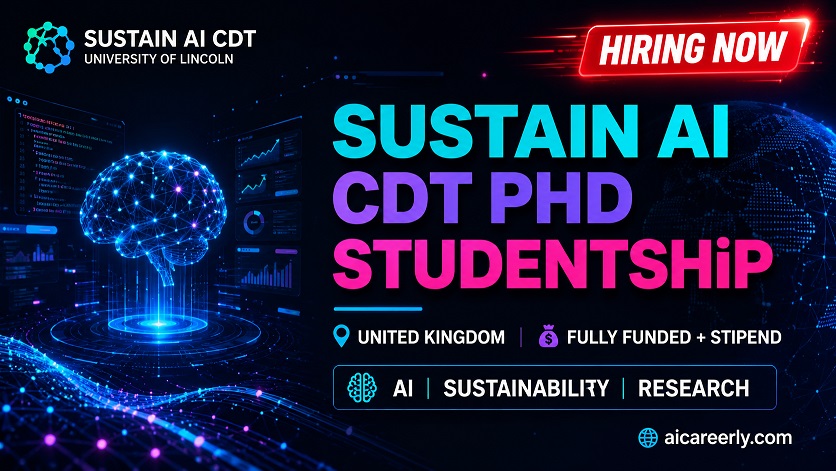
SUSTAIN AI CDT PhD Studentship – Sustainable AI Research Doctoral Programme | UKRI Funded | UK
📍 Location: gb
🏷 Type: Full-time
Job Intelligence
📍 More in this location:
Browse AI jobs in gb
🏷 Similar roles:
View similar Full-time jobs
🌐 Explore all jobs:
View all AI job listings
Job Overview
The SUSTAIN AI CDT PhD Studentship (Round 3) is a fully funded 4-year doctoral training opportunity focused on sustainable artificial intelligence, advanced computational methods, and industry-driven research challenges. Hosted across leading UK universities, this programme is designed for high-potential candidates aiming to work at the intersection of AI, environmental systems, and real-world industrial impact. The ideal applicant is a high-achieving graduate with strong analytical ability, research curiosity, and a commitment to developing responsible AI solutions that address global sustainability challenges.
📅 Job Timeline & Status
- 🏢 Company: SUSTAIN AI CDT (University of Lincoln-led consortium)
- 🟢 Job Posted: January 2026 (estimated programme cycle opening)
- ⏳ Application Deadline: 17 April 2026 (12pm BST)
- 🔄 Last Verified: 21 May 2026
- 📌 Hiring Status: Actively Hiring (Round 3 Recruitment Open)
- 🔥 Expected Response Time: 4–8 weeks post-deadline
This is an active recruitment cycle with a defined closing deadline, meaning applications are being accepted but evaluation occurs after submission closure. Competition is expected to intensify as the deadline approaches, particularly for high-demand AI and sustainability-aligned projects. Candidates should apply immediately rather than waiting, as CDT programmes typically experience high application volume in the final 2–3 weeks before closure.
Role focus: Sustainable AI PhD Research | Tech domain: Artificial Intelligence + Sustainability | Experience level: Entry-Level (0–2 years)
🌍 Work Eligibility & Location
- 🌍 Visa Sponsorship: Available for eligible international candidates (restricted nationalities apply)
- ✈️ Relocation Support: Typically available for admitted PhD candidates
- 🏠 Remote Type: Onsite / Research-Based (UK Universities)
- ⏰ Timezone Requirement: UK working hours for supervision and research coordination
- 🌐 Country Restrictions: Limited eligibility for Bangladesh, Pakistan, Cameroon, Myanmar, Afghanistan, Sudan (visa and institutional restrictions)
- 🗣️ Language Requirement: English (IELTS 6.5 or equivalent)
This is a primarily Onsite UK-based doctoral programme with occasional fieldwork or external research collaboration. International applicants are accepted under UKRI rules, but visa constraints and institutional caps may affect eligibility depending on nationality. Strong English proficiency is mandatory, and candidates must be prepared for an immersive academic research environment in the UK.
💰 Salary Intelligence
- 💰 Official Salary: UKRI PhD stipend + £10,000/year top-up (eligible home students under TechExpert pilot)
- 📊 Estimated Range: £20,000–£35,000/year equivalent total value depending on eligibility
- 📈 Level: Fully Funded PhD Studentship
This is a fully funded doctoral position rather than a traditional employment salary role. The financial package is competitive within UK PhD standards, with an additional enhancement for qualifying home students. While international candidates may not access the full top-up, the baseline UKRI stipend still provides stable funding for full-time research.
📊 Role Breakdown
The SUSTAIN AI CDT PhD programme is structured as a multi-phase research journey combining academic depth with applied industrial collaboration. In the initial year, candidates rotate across project themes and refine their research direction under expert supervision. Around 30%–40% of time is dedicated to foundational research training, including advanced machine learning, statistical modelling, and sustainability systems analysis. Candidates are expected to engage in data-driven experimentation, algorithm design, and interdisciplinary research integration.
By mid-programme, researchers typically spend 50%–60% of their effort on core thesis development, including designing novel AI models for environmental optimisation, energy systems, or industrial sustainability applications. This includes working with tools such as Python, PyTorch, TensorFlow, and advanced simulation frameworks. Collaborative industry engagement accounts for roughly 10%–20% of the programme, ensuring real-world validation of research outputs.
In the final stage, candidates focus heavily on thesis completion, publication writing, and dissemination of findings across academic and industry channels. Strong emphasis is placed on producing high-impact research outputs, including peer-reviewed publications and applied prototypes that demonstrate measurable sustainability impact.
🧩 Required Skills & Fit
- ✅ Must: First-class or 2:1 degree in Computer Science, AI, Engineering, Mathematics, or related field
- ✅ Must: Strong foundation in machine learning, statistics, or computational modelling
- ✅ Must: English proficiency equivalent to IELTS 6.5
- ➕ Bonus: Research experience in sustainability, climate tech, or AI systems
- ➕ Bonus: Publications, GitHub portfolio, or prior research internships
📈 Difficulty & Competitiveness
- ⚡ Level: Highly Competitive PhD Programme
- 📊 Experience barrier: 0–2 years (academic excellence required)
- 🧠 Skill complexity: Advanced AI research + interdisciplinary systems thinking
- 🌍 Competition: Global applicant pool with limited funded seats
This programme is considered highly selective due to its funding structure and cross-university collaboration model. Even though it is technically entry-level, applicants are expected to demonstrate near-professional research capability. Strong academic performance and clear research alignment significantly improve selection probability.
🚀 Career Impact
- ⭐ Impact Rating: ⭐⭐⭐⭐⭐
- 🏢 Brand value: UKRI-backed doctoral consortium with strong academic reputation
- 📚 Skill growth: Advanced AI research, sustainability modelling, scientific publishing
- 🚀 Future opportunities: Academic career, AI research scientist roles, climate tech leadership
This PhD pathway provides strong career acceleration into AI research, academia, and high-impact sustainability sectors. Graduates are well-positioned for roles in research labs, deep tech companies, and policy-driven AI institutions focused on environmental transformation.
📋 Key Responsibilities
Candidates will be responsible for conducting independent and supervised research into sustainable AI systems, including designing experiments, validating machine learning models, and producing peer-reviewed publications. Core duties include developing AI-driven optimisation frameworks, analysing large-scale environmental datasets, and building computational models that support sustainability decision-making. Applicants will also collaborate with academic supervisors and industry partners to ensure research relevance.
Additional responsibilities include presenting findings at academic conferences, contributing to research group discussions, and engaging in interdisciplinary collaboration across engineering, data science, and environmental domains. A strong emphasis is placed on writing research papers, maintaining reproducible codebases using Python and scientific computing tools, and contributing to innovation in sustainable AI methodologies.
🎯 Application Strategy
- 🎯 Best apply method: Submit early in cycle before deadline surge
- 🔥 Highlight: Research alignment with sustainability or AI systems
- 🔥 Highlight: Technical depth in machine learning or data science
- ❌ Avoid: Generic motivation statements without project alignment
- ❌ Avoid: Overloading application with irrelevant experience
🧠 Application Optimization (Adaptive)
This section is personalized by seniority.
How to use: Paste into ChatGPT, Claude, or Gemini
You are a senior technical recruiter.
Role:
SUSTAIN AI CDT PhD Studentship (Sustainable AI Research Doctoral Programme)
Candidate:
[Paste CV]
Optimize for this role.
Focus:
Signal strength
Role alignment
Missing high-impact elements
🧠 Fit & Positioning Analysis
Evaluate your match before applying.
Act as a hiring panel.
Evaluate:
Match score
Strengths
Gaps
Positioning improvements
📅 Application Signals
This is a high-traffic doctoral recruitment cycle with increasing competition as the 17 April 2026 deadline approaches. Most applications are expected in the final weeks, leading to compressed review cycles and selective shortlisting. Early applicants typically benefit from stronger visibility in initial screening phases.
Expect high competition, especially from AI, computer science, and engineering graduates worldwide. Interview invitations are likely to follow within 4–8 weeks after submission closure, with rapid scheduling for shortlisted candidates. Given the structured deadline, this role may close strictly without extensions, making timing critical.
Applications may close without notice.
🚀 Resume Optimization for This Role
⚡ Takes less than 2 minutes — optimize specifically for this position before applying
🎯 0/5 completed
Tailoring your CV to this exact role significantly increases your chances.
✅ Ready to apply — your profile is aligned with this role
🔗 Apply for this Job
✅ Job Source & Verification
This listing is based on official SUSTAIN CDT Round 3 recruitment information published by the University of Lincoln consortium. The data reflects a high-credibility academic source with structured funding and government-backed UKRI doctoral support. Last updated: 21 May 2026, ensuring current alignment with active application cycle details and eligibility restrictions.
Similar Jobs


Lead Software Developer (AI Solutions) – Oxford, UK | Visa + Salary Insights
Location: gb
Type: Full-time
JustHealth PhD Researcher (AI in Healthcare Ethics & Cardiology) – Leuven, Belgium | Visa + Salary Insights
Location: eu
Type: Full-time
Scientific Collaborator in AI-Enabled Precision Health – Lugano, Switzerland | Visa + Salary Insights
Location: eu
Type: Full-time
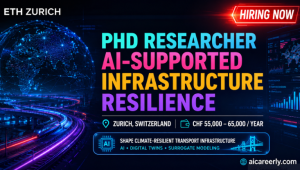
PhD Position in AI-Supported Transport Infrastructure Resilience – Zurich | Visa + Salary Insights
Location: eu
Type: Full-time