
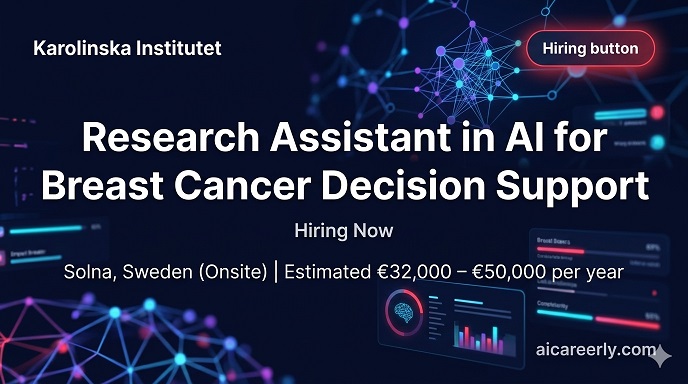
Research Assistant in AI for Breast Cancer Decision Support – Solna, Sweden | Visa + Salary Insights
📍 Location: eu
🏷 Type: Not specified
Job Intelligence
📍 More in this location:
Browse AI jobs in eu
🏷 Similar roles:
🌐 Explore all jobs:
View all AI job listings
Job Overview
This is a high-impact opportunity for a Research Assistant in AI for Breast Cancer Decision Support at Karolinska Institutet (KI), one of Europe’s leading medical research universities. The role sits within the GenAI4Care EU Horizon Europe project, focused on building a generative multi-agent AI system for multidisciplinary breast cancer care. The ideal candidate is a mid-level AI/ML researcher (0–5 years experience) with strong Python skills and interest in medical imaging, clinical AI systems, and real-world healthcare deployment. You will work closely with clinicians, engineers, and international research partners across Europe.
🌍 Work Eligibility & Location
- 🌍 Visa Sponsorship: Not explicitly stated, but KI typically supports international researchers under Swedish academic hiring pathways
- ✈️ Relocation Support: Likely available through institutional onboarding support
- 🏠 Remote Type: Onsite (Solna, Sweden)
- ⏰ Timezone Requirement: CET alignment preferred due to EU consortium collaboration
- 🌐 Country Restrictions: None specified (global applicants welcome)
- 🗣️ Language Requirement: English
This role is primarily Onsite in Solna, embedded in a clinical-research environment. While not explicitly labeled as visa-sponsored, Sweden’s academic system often facilitates work permits for qualified non-EU researchers. The role involves strong international collaboration across Europe, making it highly accessible to global talent.
💰 Salary Intelligence
- 💰 Official Salary: Not disclosed (academic research assistant scale)
- 📊 Estimated Range: €32,000 – €50,000 per year (typical KI research assistant bracket)
- 📈 Level: Mid-Level Research (AI/Medical Imaging)
While the exact salary is not published, Karolinska Institutet follows standardized Swedish academic pay bands. Compensation is competitive for Europe in research roles, especially considering exposure to EU-funded AI healthcare infrastructure, clinical deployment, and multi-country collaboration.
📊 Role Breakdown
This role is structured around three interconnected domains: AI model development, clinical data engineering, and medical validation. You will contribute to building multi-agent AI systems for breast cancer diagnostics using mammography, MRI, and clinical datasets. Approximately 40% of your time focuses on deep learning model development, including training and adapting vision models for tumor detection and characterization. Another 35% involves data engineering and system integration, where you will work with hospital systems such as EHR, PACS, and digital pathology pipelines using standards like FHIR, OMOP, and DICOM. The remaining 25% focuses on clinical evaluation, including simulation of tumor board decisions and validating AI outputs with clinicians. You will also apply explainability techniques like SHAP, Grad-CAM, and LIME to ensure model transparency in clinical settings.
🧩 Required Skills & Fit
- ✅ Must: Python programming (advanced)
- ✅ Must: Machine learning or deep learning fundamentals
- ✅ Must: Quantitative/statistical analysis skills
- ➕ Bonus: Medical imaging (MRI, mammography, pathology AI)
- ➕ Bonus: FHIR, OMOP, or DICOM experience
📈 Difficulty & Competitiveness
- ⚡ Level: High
- 📊 Experience barrier: 2–5 years
- 🧠 Skill complexity: Advanced interdisciplinary AI + clinical integration
- 🌍 Competition: Very high (EU-funded AI healthcare project)
This is a technically demanding role requiring both AI engineering capability and familiarity with clinical workflows. Competition is strong due to the prestige of KI and the scale of the EU Horizon Europe consortium. Candidates with medical imaging AI or healthcare data engineering backgrounds have a strong advantage.
🚀 Career Impact
- ⭐ Impact Rating: ⭐⭐⭐⭐⭐
- 🏢 Brand value: Karolinska Institutet + EU consortium leadership
- 📚 Skill growth: Advanced medical AI systems + multi-agent architectures
- 🚀 Future opportunities: PhD pathways, EU AI research roles, healthcare AI startups
This role provides exceptional long-term value due to exposure to clinical-grade AI systems and direct involvement in EU-scale healthcare innovation. It is a strong pipeline into PhD programs, academic research careers, or senior AI roles in medtech companies.
📋 Key Responsibilities
You will be responsible for developing and integrating AI models for breast cancer detection and prognosis using multi-modal medical data. This includes building pipelines for deep learning model training, implementing explainability frameworks using SHAP and Grad-CAM, and benchmarking performance against clinical standards. You will also design data engineering workflows across hospital systems using FHIR, OMOP, and DICOM. A major part of your role involves collaborating with clinicians to validate AI outputs through simulated multidisciplinary tumor board scenarios. You will contribute to EU deliverables, scientific papers, and presentations at international conferences. Additionally, you will help optimize system deployment using containerization tools like Docker and support multi-agent AI orchestration for decision-support systems.
🎯 Application Strategy
- 🎯 Best apply method: Direct Varbi recruitment system submission
- 🔥 Highlight: Medical imaging AI experience
- 🔥 Highlight: Python + deep learning projects
- ❌ Avoid: Generic AI-only resumes without healthcare context
- ❌ Avoid: Weak statistical or data engineering explanations
🧠 Application Optimization (Adaptive)
This section is personalized by seniority.
How to use: Paste into ChatGPT, Claude, or Gemini
Research Assistant in AI for Breast Cancer Decision Support within a multi-agent EU healthcare AI system.Candidate:
[Paste CV]Optimize for this role.
Focus:
Signal strength
Role alignment
Missing high-impact elements
🧠 Fit & Positioning Analysis
Evaluate your match before applying.
Act as a hiring panel.Evaluate:
Match score
Strengths
Gaps
Positioning improvements
📅 Application Signals
This is a high-urgency, highly competitive EU research opportunity with strong demand for AI talent in healthcare systems. Candidates with strong ML + medical imaging backgrounds should apply immediately due to limited positions and strong consortium-level collaboration requirements. Expect high competition from EU PhD-level researchers and industry AI engineers.
🚀 Resume Optimization for This Role
⚡ Takes less than 2 minutes — optimize specifically for this position before applying
🎯 0/5 completed
Tailoring your CV to this exact role significantly increases your chances.
✅ Ready to apply — your profile is aligned with this role
🔗 Apply for this Job
✅ Job Source & Verification
This listing is sourced directly from Karolinska Institutet’s official recruitment portal under a verified EU Horizon Europe research project (GenAI4Care). The information reflects the latest officially published job description (2026 intake) and is considered highly reliable for academic and research career applications within European biomedical AI programs.
Similar Jobs
JustHealth PhD Researcher (AI in Healthcare Ethics & Cardiology) – Leuven, Belgium | Visa + Salary Insights
Location: eu
Type: Full-time
Scientific Collaborator in AI-Enabled Precision Health – Lugano, Switzerland | Visa + Salary Insights
Location: eu
Type: Full-time

Assistant/Associate Professor in Embedded & Distributed AI – Palaiseau, France | Academic Salary Insights
Location: eu
Type: Contract

PhD Position in AI-Supported Transport Infrastructure Resilience – Zurich | Visa + Salary Insights
Location: eu
Type: Full-time
Postdoctoral Researcher in Machine Learning for Electric Vehicle Fleet Coordination – Gothenburg, Sweden | Visa + Salary Insights
Location: eu
Type: Full-time
Tech Lead LLM & Generative AI – Norway (Remote) | Visa + Salary Insights
Location: eu
Type: Full-time