
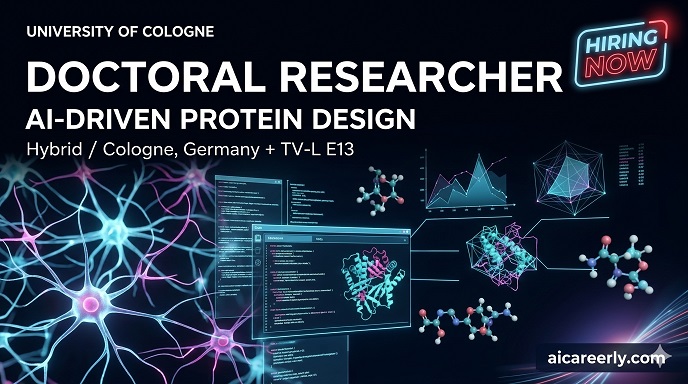
Doctoral Researcher in AI-Driven Protein Design (f/m/x) – Cologne | AI + Bioinformatics Research Role
📍 Location: eu
🏷 Type: Not specified
Job Intelligence
📍 More in this location:
Browse AI jobs in eu
🏷 Similar roles:
🌐 Explore all jobs:
View all AI job listings
Job Overview
This position is for a Doctoral Researcher / Research Assistant in AI-driven protein design at the University of Cologne’s Cologne Institute for Information Systems (CIIS). The role sits at the intersection of machine learning, computational biology, and structural protein engineering, focusing on developing advanced AI systems for biological discovery. The ideal candidate is a Master’s-level graduate or early-stage researcher with strong programming skills, ML knowledge, and an interest in protein modeling or generative AI. You will contribute to cutting-edge research in protein-protein interaction optimization and therapeutic design within an interdisciplinary academic environment.
🌍 Work Eligibility & Location
- 🌍 Visa Sponsorship: Likely available (university research positions typically support international PhD candidates)
- ✈️ Relocation Support: Not explicitly stated, but academic onboarding support is common
- 🏠 Remote Type: Hybrid / Flexible with remote work options
- ⏰ Timezone Requirement: CET (Europe-based collaboration)
- 🌐 Country Restrictions: None specified
- 🗣️ Language Requirement: English required, German is a plus
This is a highly accessible Hybrid research role based in Germany, designed for international PhD candidates. The University of Cologne promotes diversity and actively welcomes global applicants. While not explicitly stating visa sponsorship, German public universities typically provide structured support for international doctoral researchers, especially in funded E13 positions.
💰 Salary Intelligence
- 💰 Official Salary: TV-L E13 (German public sector scale)
- 📊 Estimated Range: ~€4,000–€5,800/month gross (full-time equivalent, pro-rated to part-time ~27.88 hours/week)
- 📈 Level: Entry-to-Mid Research (Doctoral Level)
This role follows the German public academic pay scale, making it a stable and competitive PhD-level position. While not industry-level compensation, the TV-L E13 salary structure offers strong job security, research funding access, and long-term academic career value.
📊 Role Breakdown
This position focuses on developing next-generation AI systems for protein engineering. You will work on machine learning pipelines that predict and optimize protein binding behavior in protein-protein interaction (PPI) contexts. A core responsibility is building and extending generative AI models and hybrid scoring frameworks that combine learned representations with physics-informed biological constraints. You will actively contribute to the design of protein binders for therapeutic targets, requiring strong integration of deep learning models, structural biology insights, and computational chemistry principles.
A significant part of the role involves developing multi-modal scoring functions that merge AI-based predictions with physics-based validation. Expect to work with experimental and in-silico datasets, refine model architectures, and benchmark results against international protein design challenges. Around 40% of your time will be dedicated to model development, 30% to simulation and validation workflows, and 30% to research experimentation and benchmarking. Strong coding in Python, ML frameworks, and pipeline orchestration tools is essential.
🧩 Required Skills & Fit
- ✅ Must: Master’s degree in Bioinformatics, CS, Computational Biology, or related field
- ✅ Must: Strong programming skills (Python + ML frameworks)
- ✅ Must: Machine learning, deep neural networks, or generative models
- ➕ Bonus: Structural biology or protein modeling experience
- ➕ Bonus: Computational chemistry or biophysics knowledge
📈 Difficulty & Competitiveness
- ⚡ Level: Advanced Research Position
- 📊 Experience barrier: 0–3 years (Master’s or early research experience)
- 🧠 Skill complexity: High (AI + biology + physics integration)
- 🌍 Competition: High (international PhD applicants)
This is a technically demanding role requiring strong interdisciplinary ability. Competition is significant due to the combination of AI research + computational biology. Candidates with prior exposure to protein modeling or generative AI will have a strong advantage.
🚀 Career Impact
- ⭐ Impact Rating: ⭐⭐⭐⭐⭐
- 🏢 Brand value: Leading German research university (University of Cologne)
- 📚 Skill growth: Advanced AI, protein design, and scientific ML systems
- 🚀 Future opportunities: PhD, biotech AI roles, research labs, pharma AI teams
This role provides strong long-term positioning in AI-driven biotech research. It is a gateway into high-impact domains such as drug discovery, computational protein engineering, and academic AI research careers.
📋 Key Responsibilities
You will be responsible for building and improving AI-driven protein design pipelines that integrate machine learning and biological modeling. Key tasks include designing protein binding prediction models, optimizing protein structures for target interactions, and developing hybrid scoring systems combining physics-based models with deep learning architectures.
You will also evaluate model performance using experimental datasets and simulation outputs, participate in international benchmarks, and contribute to research publications. Additional responsibilities include experimenting with generative AI techniques for biomolecular design, maintaining scalable ML pipelines, and collaborating with interdisciplinary teams across computational biology, chemistry, and information systems research domains.
🎯 Application Strategy
- 🎯 Best apply method: University job portal submission (formal academic CV + publications)
- 🔥 Highlight: ML systems and Python engineering experience
- 🔥 Highlight: Biology/structural modeling exposure
- ❌ Avoid: Generic AI resumes without biological context
- ❌ Avoid: Weak academic framing for research roles
🧠 Application Optimization (Adaptive)
This section is personalized by seniority.
How to use: Paste into ChatGPT, Claude, or Gemini
You are a senior technical recruiter.
Role:
Doctoral Researcher in AI-driven protein design focusing on ML-based protein modeling, hybrid physics-AI scoring, and biomolecular generative systems.
Candidate:
[Paste CV]
Optimize for this role.
Focus:
Signal strength
Role alignment
Missing high-impact elements
🧠 Fit & Positioning Analysis
Evaluate your match before applying.
Act as a hiring panel.
Evaluate:
Match score
Strengths
Gaps
Positioning improvements
📅 Application Signals
This role is time-sensitive with a structured academic deadline. Expect high competition due to its interdisciplinary AI + biology focus. Early applicants with strong ML + computational biology alignment will stand out significantly. Ensure submission before the deadline to avoid exclusion from review cycles.
🚀 Resume Optimization for This Role
⚡ Takes less than 2 minutes — optimize specifically for this position before applying
🎯 0/5 completed
Tailoring your CV to this exact role significantly increases your chances.
✅ Ready to apply — your profile is aligned with this role
🔗 Apply for this Job
✅ Job Source & Verification
This role is sourced from the University of Cologne official job portal, a highly credible academic institution. The listing reflects a formal doctoral research position under the CIIS institute. Last updated: May 2026. All details align with German public sector research employment standards and TV-L E13 classification rules.
Similar Jobs
JustHealth PhD Researcher (AI in Healthcare Ethics & Cardiology) – Leuven, Belgium | Visa + Salary Insights
Location: eu
Type: Full-time
Scientific Collaborator in AI-Enabled Precision Health – Lugano, Switzerland | Visa + Salary Insights
Location: eu
Type: Full-time
Assistant/Associate Professor in Embedded & Distributed AI – Palaiseau, France | Academic Salary Insights
Location: eu
Type: Contract
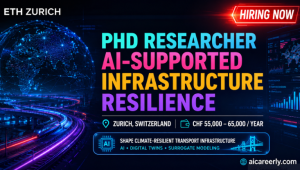
PhD Position in AI-Supported Transport Infrastructure Resilience – Zurich | Visa + Salary Insights
Location: eu
Type: Full-time
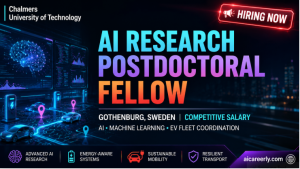
Postdoctoral Researcher in Machine Learning for Electric Vehicle Fleet Coordination – Gothenburg, Sweden | Visa + Salary Insights
Location: eu
Type: Full-time
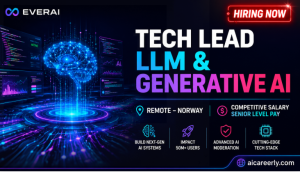
Tech Lead LLM & Generative AI – Norway (Remote) | Visa + Salary Insights
Location: eu
Type: Full-time